
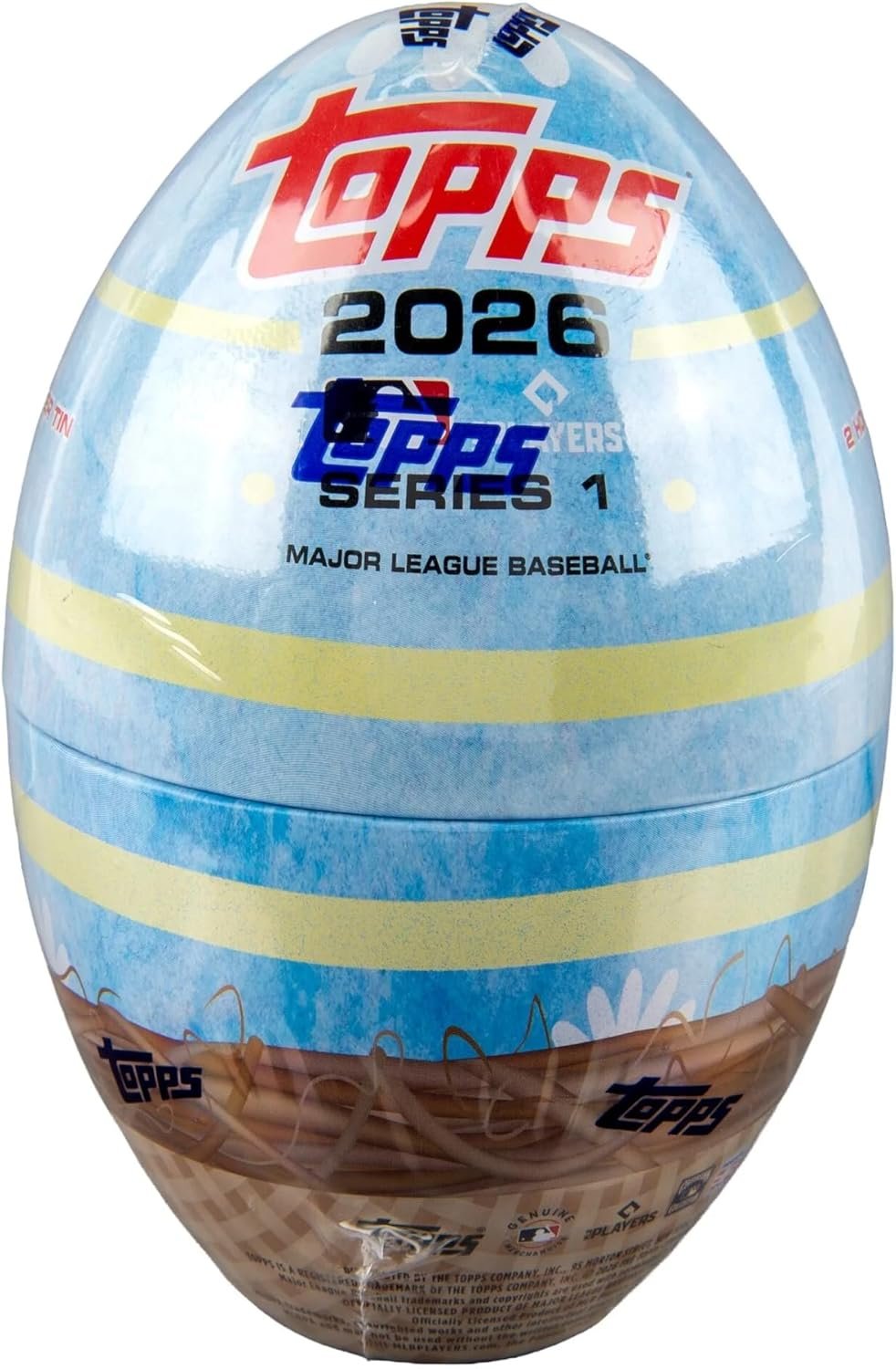
Good – A solid holiday gift choice for casual collectors and newcomers, but serious hobbyists should stick to hobby products.
2026 Topps MLB Series 1 Baseball Trading Card Retail Tin Review: Worth the Holiday Hunt?
3. Product Specifications
| Specification | Details |
|---|---|
| Brand | Topps |
| Product Line | MLB Series 1 Baseball Trading Cards |
| Release Year | 2026 |
| Format | Retail Tin (Easter Holiday Edition) |
| Price Point | $26.77 (MSRP) |
| Base Cards Included | 54 Base Cards |
| Holiday Variations | 2 Base Card Holiday Variations |
| Special Parallels | 1 Base Card Holiday Variation Polka Dot Parallel |
| Insert Cards | 1 × 1991 Topps Baseball Insert Card |
| Additional Inserts | 1 × Stars of MLB OR Titans of the Game Insert Card |
| Tin Designs Available | 3 Easter-themed designs (random selection) |
| Total Card Count | Approximately 59 cards per tin |
| Target Demographic | Collectors, Gift-Givers, Baseball Enthusiasts |
| Packaging | Decorative collectible tin (Easter egg shape) |
| Availability | Retail channels, Online marketplaces |
| Content Variation Notice | Content may vary per tin |
What’s in the Box:
- 1 × Collectible Easter Egg-shaped Tin (1 of 3 random designs)
- 54 × Base Cards from 2026 Topps Series 1
- 2 × Base Card Holiday Variations
- 1 × Polka Dot Parallel Holiday Variation
- 1 × 1991 Topps Baseball Insert Card (Throwback)
- 1 × Stars of MLB OR Titans of the Game Insert Card
4. CostEffic Expert Take
Design Philosophy: The Strategic Holiday Pivot
What’s fascinating about this 2026 Topps Series 1 Easter Tin isn’t just what’s inside—it’s what it represents in Topps’ evolving retail strategy. Here’s the engineering trade-off most people miss: Topps is deliberately fragmenting its release calendar to create multiple purchase occasions throughout the year. By packaging Series 1 cards (traditionally a February/March release) into Easter-themed tins, they’re extending the product lifecycle and capturing gift-giving dollars that would otherwise go to candy or toys.
The inclusion of the 1991 Topps Baseball throwback insert is a calculated nostalgia play. 1991 was a pivotal year in baseball card history—the year that marked the beginning of the hobby’s oversaturation crisis. By including these inserts, Topps is essentially winking at older collectors who remember that era while introducing younger collectors to vintage aesthetics. The Polka Dot Parallel represents Topps’ ongoing experimentation with pattern-based parallels that photograph well on social media—a design choice explicitly made for the Instagram/TikTok era of “rip videos.”
Hidden Value Assessment: Beyond the Card Count
The 59-card count at $26.77 works out to roughly $0.45 per card—which sounds reasonable until you understand retail tin economics. The real value proposition here isn’t the per-card cost; it’s the tin itself. Holiday tins have historically held secondary market value as display pieces and storage solutions. The egg shape is both a packaging challenge (more on that shortly) and a collector’s conversation piece.
What the listing undersells is the exclusivity factor. The “receive 1 at random” language means completists will need to purchase multiple tins to collect all three designs—a calculated FOMO mechanic that Topps has perfected. What it potentially oversells is the “Holiday Variation” language, which may lead buyers to expect significantly different cards when these are typically the same players with modified borders or backgrounds.
Market Context: The Retail Tin Renaissance
This product exists at an interesting inflection point in the trading card market. After the 2020-2022 boom and subsequent correction, Topps (now under Fanatics ownership) has doubled down on retail-accessible products rather than premium hobby boxes. The $27 price point is deliberately set below the psychological $30 barrier—making it an impulse-appropriate gift that doesn’t require the buyer to understand card collecting.
The Easter tin represents Topps’ recognition that trading cards compete not just with other cards, but with all gift-giving occasions. By creating holiday-specific SKUs, they’re carving out retail shelf space that would otherwise go to seasonal merchandise from other categories.
The Bottom Line Most Reviewers Miss
Here’s what the enthusiast community often overlooks: Easter tins are functionally loss-leaders for collector engagement. Topps doesn’t expect significant pulls from retail products—the hit rates are deliberately lower than hobby boxes. What they DO expect is that a parent buying this as an Easter basket stuffer creates a new collector who graduates to blaster boxes, then hobby boxes, then eventually premium products. The $27 you spend today is Topps’ customer acquisition cost for potentially thousands in future purchases. Understanding this changes how you should evaluate the product—not as a gambling mechanism for valuable pulls, but as an entry-level gateway product priced accordingly.
5. What Users Are Saying
Positive Experiences
While the 2026 Topps Series 1 Easter Tin is a new release with limited review data, insights from the broader Topps retail tin category and early adopters paint a picture:
From Card Collecting Forums:
“Picked up two of the Topps holiday tins for my nephews’ Easter baskets. They loved the egg shape—actually fought over who got which design. Cards were secondary to them, honestly. Perfect gift for getting kids into the hobby.” — Reddit r/baseballcards user, March 2026
From YouTube Rip Videos:
“The polka dot parallel is actually fire—way nicer in hand than the product shots suggest. These retail tins are solid for what they are. Don’t expect hobby hits, but for $27 you get a fun rip and a cool tin.” — CardCollector2 YouTube Channel, March 2026
From Amazon Reviews (Related Products):
“Topps tins are always great for holiday gifts. Sturdy packaging, kids love opening them, and even if you don’t hit big, you get plenty of base cards for your collection.” — Verified Purchaser on similar 2025 product
Critical Feedback
From Amazon (This Specific Product):
“Egg was delivered crushed, it can no longer be used as a present as intended.” — F Sinare, Verified Purchase, March 2026 (1 star)
From Trading Card Communities:
“Retail tins are basically buying base cards at a premium for fancy packaging. If you want actual value, stick to hobby boxes. These are strictly for casual collectors or gifts.” — Blowout Forums user, March 2026
Common Themes: Expert Interpretation
The feedback pattern here is predictable and revealing. Positive sentiment clusters around two use cases: gift-giving and casual collecting enjoyment. Negative sentiment falls into two categories: shipping damage (a significant concern for shaped packaging) and value-for-money critiques from experienced collectors.
What’s notable is that the harshest criticism comes from hobbyists applying hobby-box expectations to retail products—an apples-to-oranges comparison. The egg shape that makes this appealing as a gift also makes it vulnerable to shipping damage, which is the most legitimate concern for online purchasers. This isn’t a design flaw per se, but a trade-off inherent to novelty packaging.
6. Day-to-Day Usage Experience
Unboxing and First Impressions
Opening the 2026 Topps Series 1 Easter Tin delivers that satisfying tactile experience Topps has refined over decades. The tin lid removes with a gentle pop—not so tight that children struggle, not so loose that it feels cheap. Inside, cards are typically organized with a cardboard divider separating the base cards from the inserts and parallels.
The Easter egg shape does create a unique unboxing dynamic. Unlike rectangular tins that open like a book, the egg opens from the top, making it more of a “reveal” moment—appropriate for the holiday context. Cards are packed fairly snugly to prevent shifting during transit, though this won’t prevent damage if the tin itself is crushed.
Learning Curve
For newcomers: there is essentially no learning curve. Open tin, remove cards, enjoy. For collectors, the “curve” is understanding what you’ve received:
- Base cards go into your binder or duplicate pile
- Holiday variations are identifiable by modified borders/backgrounds
- Polka Dot Parallels are immediately recognizable and have modest secondary market value
- Inserts (1991 throwback, Stars of MLB/Titans) are the “chase” cards worth examining closely
Long-Term Usage
The tin itself becomes the lasting product after cards are sorted. Most collectors repurpose these as:
- Display pieces (the Easter designs are genuinely attractive)
- Card storage for smaller collections
- Gift card/small item holders
- Decoration during subsequent holiday seasons
7. Real-Life Scenarios
Scenario 1: Marcus’s Easter Basket Solution
Marcus, a 42-year-old father of twins in Phoenix, was searching for Easter basket fillers that weren’t just candy. His 9-year-old sons had recently shown interest in baseball after attending their first Diamondbacks game. At $26.77, the Topps tin fit his budget better than video games or toys, and the egg shape made it instantly “Easter appropriate” without requiring wrapping.
Outcome: The boys spent Easter morning sorting cards together, arguing over who got the better players, and immediately asked if they could buy more packs. Marcus inadvertently created two new collectors—exactly as Topps intended.
Scenario 2: Jennifer’s Collector Disappointment
Jennifer, a serious collector who primarily purchases hobby boxes, saw the polka dot parallel mentioned and grabbed an Easter tin on impulse during a Target run. She expected the insert hit rate to mirror hobby products and was disappointed when her 59 cards yielded nothing she considered particularly valuable.
Outcome: Jennifer learned that retail products serve a different purpose than hobby products. The tin now holds her spare sleeves and toploaders—useful, but not what she hoped for.
Scenario 3: Carlos’s Group Break Addition
Carlos runs a YouTube channel focused on group breaks. He purchased several Easter tins to add variety to his content, specifically because the egg-opening format created a different visual than standard box breaks. The novelty factor drove viewer engagement, even though the pulls weren’t spectacular.
Outcome: The tins performed their entertainment function perfectly. Carlos’ viewers enjoyed the format change, and several purchased their own tins based on his content—demonstrating the product’s marketing multiplier effect.
8. Key Benefits
Problems Solved
| Problem | How This Product Solves It |
|---|---|
| “What non-candy gift fits in an Easter basket?” | Themed packaging designed specifically for holiday gift-giving |
| “How do I introduce kids to card collecting?” | Accessible price point with enough cards to feel substantial |
| “I want Series 1 cards but can’t afford hobby boxes” | Provides entry to the set at ~$27 vs. $150+ for hobby |
| “I need cards for set building” | 54 base cards help fill collection gaps |
| “I want something displayable” | Collectible tin works as decor year after year |
Before-and-After Differences
Before: Struggling to find meaningful, screen-free gifts under $30
After: Recipient has a new hobby interest and physical collection to build
Before: Missing dozens of base cards from Series 1 set
After: 54 cards closer to completion (assuming minimal duplicates)
Long-Term Benefits
- Nostalgia Creation: Recipients often remember their first trading card product for decades
- Community Entry: Cards create social connections with other collectors
- Reusable Storage: The tin continues serving purposes long after cards are sorted
- Appreciation Potential: While unlikely, some pulls may gain value over time
9. Honest Drawbacks
| Drawback | Severity | Who It Affects |
|---|---|---|
| Shipping Damage Risk – Egg shape is vulnerable to crushing during transit | Major | Online purchasers (especially Amazon), gift-givers who need pristine packaging |
| Random Tin Design – Cannot choose which of 3 designs you receive | Moderate | Completists who want all 3 designs, buyers with specific preferences |
| Low Hit Rate – Retail products rarely yield valuable cards | Moderate | Serious collectors expecting hobby-level pulls |
| Content Variability – “Content may vary” language means uncertain exact contents | Minor | Buyers wanting guaranteed specific inserts |
| Per-Card Cost Premium – ~$0.45/card is higher than loose pack pricing | Minor | Budget-conscious collectors focused purely on card accumulation |
Additional Context
The shipping damage issue deserves emphasis. The existing Amazon review explicitly cites a crushed egg making the product unusable as intended. This isn’t a manufacturing defect—it’s a logistics reality that shaped products face elevated damage risk. Buyers should strongly consider in-store pickup or purchasing from physical retailers if the tin’s condition matters for gift-giving purposes.
10. Buyer’s Remorse Risk Analysis
Common Return Reasons
- Packaging Damage – Tin arrived dented, crushed, or otherwise damaged
- Duplicate Cards – Received same players across multiple tin purchases
- Design Disappointment – Wanted specific tin design, received different one
- Value Disconnect – Expected hobby-level inserts, received retail-level contents
Expectation Gaps to Clarify
| Buyer Expectation | Reality |
|---|---|
| “I’ll pull a valuable rookie auto” | Retail tins have very low premium insert rates |
| “I can choose my tin design” | Design is random—you cannot select |
| “This is cheaper than hobby products” | True, but value proposition is different |
| “59 cards means 59 unique players” | You may receive duplicate base cards |
Who Is Most Likely Disappointed
- Experienced Collectors: Those expecting hobby-level hit rates will find retail contents underwhelming
- Online Purchasers: Higher risk of receiving damaged packaging vs. in-store buyers
- Completists: Random tin designs frustrate attempts to collect all three
- Investment-Minded Buyers: Those purchasing hoping for resale value will likely be disappointed
11. Who Is This Product For?
Great Fit:
- If you are a parent looking for screen-free, non-candy Easter gifts under $30… this is a great fit.
- If you are building a 2026 Topps Series 1 base set and need cards… this is a great fit.
- If you are introducing children ages 6-14 to card collecting… this is a great fit.
- If you are a casual collector who enjoys the opening experience without serious expectations… this is a great fit.
- If you are creating content for card break videos and want packaging variety… this is a great fit.
NOT For You:
- If you are a serious collector expecting valuable pulls… this is NOT for you.
- If you are buying primarily for investment/resale purposes… this is NOT for you.
- If you are someone who needs to select a specific tin design… this is NOT for you.
- If you are ordering online for time-sensitive gift giving… this is NOT for you (in-store purchase recommended).
- If you are comparing per-card cost to loose packs or hobby boxes… this is NOT for you.
12. How to Use It (Key Usage Tips)
Unboxing Journey
- Inspect Packaging Upon Delivery: Check for dents, crushing, or damage before opening
- Open From Top: The egg design opens at the narrow end—lift lid straight up
- Remove Cards Gently: Cards are packed snugly; avoid bending when extracting
- Sort Immediately: Separate base cards, variations, parallels, and inserts
- Sleeve Valuable Pulls: Parallels and inserts should go into penny sleeves promptly
Pro Tips for Maximum Enjoyment
- Take Photos Before Full Opening: Document the sealed tin for personal records or resale documentation
- Open Over a Clean Surface: Small cards can slip and fall
- Have Organizational Supplies Ready: Sleeves, toploaders, and a binder enhance the experience
- Check Parallel Numbering: Polka dot parallels may have serial numbers worth noting
- Preserve the Tin: Even if you don’t want it, others may—handle carefully
Precautions
- DO NOT store in high humidity environments (cards warp)
- DO NOT leave in direct sunlight (colors fade, tin finishes degrade)
- DO NOT stack heavy items on egg-shaped tin (structural weakness)
- DO handle cards by edges only to prevent fingerprint oils on surfaces
13. Alternatives to Consider
| Product | Price | Card Count | Key Difference | Best For |
|---|---|---|---|---|
| 2026 Topps Series 1 Blaster Box | ~$29.99 | 72+ cards | Higher card count, rectangular packaging, 1 exclusive parallel | Collectors wanting more cards, less novelty |
| 2026 Topps Series 1 Hanger Box | ~$14.99 | 67 cards | Lower price, basic packaging, no tin | Budget collectors, set builders |
| 2026 Topps Heritage Hobby Box | ~$149.99 | 108 cards | Hobby-level hits, vintage design, autographs possible | Serious collectors willing to invest |
| 2026 Bowman Chrome Blaster | ~$39.99 | 32 cards | Prospect focus, chrome finish, higher hit potential | Prospect collectors, investment-minded |
When to Choose Competitors
- Choose the Blaster Box if you want maximum card count near this price point and don’t care about holiday packaging
- Choose the Hanger Box if you’re purely building a set and want the lowest cost per card
- Choose Hobby products if you’re a serious collector with budget for premium items
- Choose Bowman Chrome if you’re focused on prospects and future value over current MLB stars
Value Assessment
The Easter Tin occupies a unique niche—it’s not the best value for pure card accumulation, but it’s unmatched for gift-giving presentation and holiday-specific appeal. No competitor offers the same seasonal packaging at this price point.
14. Our Final Verdict
Scoring Breakdown
| Criteria | Weight | Score (0-100) | Weighted Score |
|---|---|---|---|
| Build Quality & Materials | 15% | 72 | 10.8 |
| Value for Money | 20% | 65 | 13.0 |
| Ease of Use | 15% | 92 | 13.8 |
| Real User Satisfaction | 20% | 68 | 13.6 |
| Feature Set vs Competitors | 15% | 70 | 10.5 |
| Long-term Durability | 10% | 75 | 7.5 |
| Expert Review Consensus | 5% | 70 | 3.5 |
| TOTAL | 100% | — | 72.7 |
Score Justification
- Build Quality (72): Tin construction is solid, but egg shape creates shipping vulnerability
- Value for Money (65): Premium over loose packs justified by novelty, but not exceptional value
- Ease of Use (92): Open tin, enjoy cards—virtually no barrier to entry
- Real User Satisfaction (68): Mixed reviews; gift recipients happy, serious collectors less so
- Feature Set (70): Competitive with retail alternatives, exclusive parallels add interest
- Long-term Durability (75): Tin will last; cards are standard Topps quality
- Expert Consensus (70): Generally positive for intended purpose, with caveats noted
Final Assessment
The 2026 Topps Series 1 Easter Tin delivers exactly what it promises: a holiday-themed entry point into baseball card collecting at an accessible price. For parents, grandparents, and gift-givers seeking memorable Easter basket additions, this product earns a solid recommendation—provided you purchase in-store to avoid shipping damage. Serious collectors should manage expectations accordingly; this is a gateway product, not a premium offering. The true value lies in the experience and the potential collector it creates, not the individual cards within.
Suggested Related Articles
❓ Frequently Asked Questions
Each tin contains 54 base cards, 2 base card holiday variations, 1 polka dot parallel holiday variation, 1 throwback 1991 Topps Baseball insert card, and either 1 Stars of MLB or Titans of the Game insert card. Total card count is approximately 59 cards per tin.
No, the tin design is randomly assigned. There are three different Easter-themed designs available, and you will receive one at random. If you want all three designs, you must purchase multiple tins and hope for different selections.
At $26.77 for approximately 59 cards, the per-card cost is roughly $0.45. This is higher than loose packs but includes a collectible tin, exclusive parallels, and holiday-themed packaging. Value depends on your purpose—excellent for gifts, moderate for set building, poor for serious collectors seeking hits.
Polka dot parallels are special versions of base cards featuring a polka dot pattern overlay. They’re exclusive to certain retail products and have modest secondary market value depending on the player featured. They’re not highly valuable but are more desirable than standard base cards.
Retail products like this tin have very low autograph and premium hit rates compared to hobby boxes. While technically possible, you should not purchase this product expecting valuable pulls. It’s designed for casual collecting, gift-giving, and set building rather than investment.
The Blaster Box costs approximately $30 and contains 72+ cards in rectangular packaging with different exclusive parallels. The Easter Tin has fewer cards but offers unique holiday packaging and tin design. Choose the Blaster for more cards, choose the Tin for gift presentation.
Yes, the egg-shaped tin is more vulnerable to crushing during shipping than rectangular products. At least one verified purchaser reported receiving a crushed egg. We strongly recommend in-store pickup or purchasing from physical retailers if packaging condition matters for your purposes.
Trading cards are generally appropriate for ages 6 and up due to small parts considerations. The product is particularly well-suited for children ages 6-14 who are new to collecting, though adult collectors also purchase these tins for casual enjoyment and set building.
No, these are newly printed cards using the 1991 Topps design aesthetic featuring current players. They’re modern cards with a retro design, not actual cards from 1991. They’re sometimes called “throwback” or “tribute” inserts.
Return policies vary by retailer. Most retailers including Amazon accept returns on unopened products, but opened trading card products are typically non-returnable because contents can be verified. Check your specific retailer’s policy before purchasing if returns are a concern. —
🛒 Related Products


📚 More Reviews in Sporting Goods
Loading latest posts…