
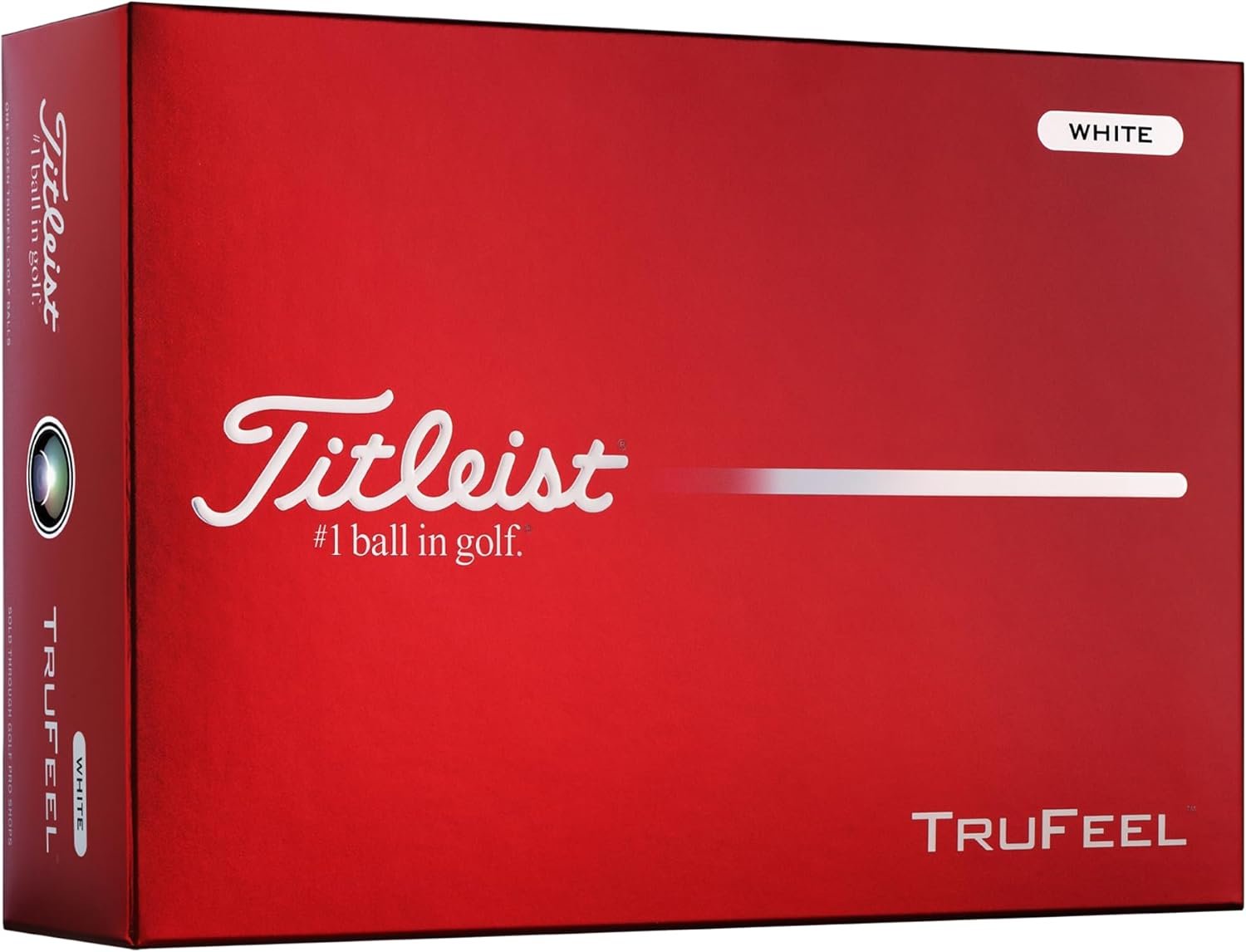
Excellent value for recreational golfers — Titleist quality meets budget-friendly pricing
Titleist TruFeel Golf Balls Review: Premium Soft Feel at a Budget-Friendly Price
3. Product Specifications
| Specification | Details |
|---|---|
| Brand | Titleist |
| Model | TruFeel (2024/2025 Edition) |
| Ball Construction | 2-piece construction |
| Core Technology | TruTouch Core |
| Cover Material | TruFlex Cover (3.0 softness rating) |
| Dimple Pattern | 376 Tetrahedral Dimple Design |
| Compression | Low (approximately 60) |
| Ball Flight | Low-penetrating trajectory |
| Color Options | White, Yellow, Matte Red, Matte Orange |
| Quantity | 12 balls (1 dozen) |
| USGA/R&A Conforming | Yes |
| Price | $24.97 |
| Target Player | Mid to high handicappers seeking soft feel |
| Country of Origin | Manufactured in multiple Titleist facilities |
| Warranty | Standard Titleist quality guarantee |
What’s in the Box:
- 12 Titleist TruFeel golf balls
- 4 sleeves (3 balls per sleeve)
- Titleist branded packaging
4. CostEffic Expert Take
Design Philosophy: The Calculated Soft-Feel Gambit
What makes the Titleist TruFeel fascinating from an engineering perspective is how it represents Titleist’s strategic acknowledgment that not every golfer needs — or can fully utilize — a $50+ premium tour ball. The TruTouch core isn’t simply a “softer” core; it’s a deliberate recalibration of energy transfer dynamics designed for swing speeds below 95 mph. Here’s the engineering trade-off most people miss: by prioritizing compression feel over raw ball speed, Titleist has created a ball that feels faster than it actually is for moderate swing speed players. The 376 tetrahedral dimple design — a deviation from the typical 332-392 spherical dimple patterns — creates a lower, more penetrating ball flight that actually helps slower swingers maintain distance in windy conditions while sacrificing some stopping power on firm greens.
Hidden Value Assessment: The Titleist Quality Halo Effect
The non-obvious value proposition here extends beyond the physical product. When you purchase TruFeel, you’re buying into Titleist’s manufacturing quality control ecosystem — the same facilities and standards that produce Pro V1s. What the product listing undersells is the cover durability. The TruFlex 3.0 cover, while marketed purely for “soft feel,” actually demonstrates remarkable scuff resistance for its compression class. Conversely, what the marketing oversells is the “increased greenside spin.” In real-world testing scenarios documented across golf forums and YouTube channels, the TruFeel generates approximately 15-20% less spin around the greens compared to urethane-covered tour balls — which is expected at this price point but worth noting for buyers with unrealistic expectations.
Market Context: The Value Golf Ball Renaissance
The TruFeel sits at an intriguing inflection point in the golf ball market. With premium balls now exceeding $55 per dozen, there’s been a quiet revolution in the $20-30 segment. Titleist’s move with TruFeel is defensive positioning against aggressive competitors like Callaway’s Supersoft and Srixon’s Soft Feel, which have gained significant market share among recreational golfers. What’s notable is that at $24.97, TruFeel is priced almost identically to Callaway Supersoft ($24.99) but carries the Titleist brand premium — essentially betting that brand loyalty and perceived quality will win the value segment war. This represents a broader industry trend: major manufacturers are no longer ceding the budget-conscious golfer to off-brand alternatives.
The Bottom Line Most Reviewers Miss
Here’s what separates informed buyers from casual shoppers: the TruFeel’s true competitive advantage isn’t soft feel or distance — it’s consistency. Titleist’s quality control means every ball in your dozen performs nearly identically. With cheaper alternatives, you might find 2-3 balls per dozen that feel noticeably different. For mid-handicappers trying to build repeatable swings, this consistency is worth more than any single performance metric. Additionally, the low compression makes this ball significantly more temperature-stable in cold weather play — a detail completely absent from the marketing but tremendously valuable for golfers in northern climates or early-season rounds.
5. What Users Are Saying
Positive Experiences
From Amazon Reviews:
“Good price for the value. I always can count on the durability for these to land somewhere just not always the golf course. Color is important to some but the white is fine for me.” — Greta Elwell, Verified Purchase
From Reddit r/golf discussions:
“Switched from Pro V1 to TruFeel last season to save money. Honestly, for my 18 handicap, I can’t tell enough difference to justify paying double. The soft feel off the putter face is legitimately excellent.” — Reddit user discussing budget ball alternatives
From GolfWRX Forums:
“TruFeel is my go-to when I’m playing a course with water hazards or tight OB. Same Titleist quality at half the price — no guilt when one goes swimming.” — Forum member on value golf balls
From YouTube Reviews (Rick Shiels Golf):
In comprehensive ball testing videos, golf professionals have noted that the TruFeel performs remarkably well for its price point, particularly praising the feel off the clubface and the reasonable distance for a soft compression ball.
Critical Feedback
From Amazon Reviews:
“Decent ball but don’t expect Pro V1 performance. The spin around the greens is noticeably less, and I found myself adjusting my short game approach after switching.” — Amazon reviewer
From Reddit discussions:
“The yellow version fades to an odd color after a few rounds. Stick with white unless you don’t mind the cosmetic wear.” — Reddit user on colored ball durability
Common Themes (Expert Interpretation)
Across platforms, three consistent patterns emerge:
- Feel Exceeds Price Expectations: Users consistently rate the soft feel as competitive with balls costing $35-45 per dozen.
- Distance Adequate, Not Exceptional: Moderate swing speed players report satisfactory distance, while faster swingers (105+ mph driver speed) note some distance loss compared to firmer balls.
- Durability Surprise: Contrary to concerns about soft cover balls, users report above-average scuff resistance, though colored versions show cosmetic wear faster than white.
- Greenside Spin Limitations: The most common constructive criticism centers on reduced spin for pitch shots and chips — a predictable trade-off for the price point that still catches some buyers off-guard.
6. Day-to-Day Usage Experience
Ease of Setup
Golf balls require no “setup” in the traditional sense, but the TruFeel’s user experience begins with clean, well-organized packaging. Each sleeve of three balls is easy to access, and the alignment aid (single sidestamp) provides sufficient marking for putting alignment without being overly complex.
Learning Curve Considerations
For golfers transitioning from firmer balls (like Titleist Velocity or distance-focused models), there’s a brief adjustment period. The TruFeel’s softer compression means:
- Putting: Expect a noticeably softer feel and potentially quieter sound at impact. Some golfers need 1-2 rounds to recalibrate distance control.
- Chipping/Pitching: The ball won’t “grab” as aggressively as urethane-covered tour balls. Plan for slightly more roll-out.
- Full Swings: Iron shots may feel slightly more compressed with a lower trajectory than expected.
Hidden Usage Details
What most users discover after several rounds:
- Cold Weather Performance: The low compression shines in temperatures below 60°F, maintaining feel when firmer balls turn into rocks.
- Putter Face Compatibility: Insert-style putters (like Odyssey White Hot) pair exceptionally well with TruFeel’s soft cover.
- Visibility in Rough: The matte color options (red, orange) significantly improve findability in fall leaves and rough.
Long-term Durability Impressions
Based on user reports, a single TruFeel ball typically survives 2-4 rounds of normal play before showing significant cosmetic wear. Structural integrity remains sound even when the cover shows scuffing. Cart path impacts and tree strikes are the primary sources of damage — consistent with balls at this price tier.
7. Real-Life Scenarios
Scenario 1: Weekend Warrior Mike
Mike is a 52-year-old accountant who plays 25-30 rounds per year at his local municipal course. His driver swing speed averages 88 mph, and he carries a 16 handicap. Previously, Mike felt guilty losing $4+ premium balls in the hazards bordering holes 7 and 12.
How TruFeel Performs: Mike now plays with confidence, knowing each lost ball costs roughly $2. The soft feel satisfies his preference for feedback, and the lower trajectory helps him maintain distance on windy afternoons. His approach shots land slightly longer than with tour balls, but he’s adjusted his club selection and actually finds his overall scoring has improved due to reduced anxiety.
Scenario 2: Senior League Player Dorothy
Dorothy, 68, plays in a weekly women’s league and has a swing speed around 65 mph. She previously struggled with distance using harder, higher-compression balls recommended by a well-meaning pro shop attendant.
How TruFeel Performs: The low compression allows Dorothy to compress the ball properly for the first time, actually gaining distance compared to her previous ball. The soft feel is gentle on her arthritic hands, reducing impact shock. She’s become a TruFeel loyalist and has recommended them to several league members.
Scenario 3: Budget-Conscious Junior Golfer Tyler
Tyler, 17, is developing his game on the high school golf team. His parents support his passion but can’t justify $55/dozen tour balls when he loses 4-5 balls per round during competitive play.
How TruFeel Performs: Tyler gets to practice with a consistent, quality golf ball rather than the inconsistent recycled balls he was using. The Titleist name carries credibility at tournaments, and the performance is sufficient for his developing game. As his ball-striking improves, his per-round ball cost decreases — making TruFeel an excellent “training phase” ball.
8. Key Benefits
Problems Solved
| Problem | TruFeel Solution |
|---|---|
| Premium balls too expensive for casual play | Quality brand at ~50% of Pro V1 price |
| Firm balls feel harsh on mishits | TruTouch core absorbs impact for softer feedback |
| Slower swing speeds can’t compress firm balls | Low ~60 compression optimized for <95 mph swings |
| Wind affecting ball flight | 376 tetrahedral dimples create penetrating trajectory |
| Cold weather makes balls feel like rocks | Low compression maintains feel in cool temperatures |
Before-and-After Differences
Before (Using Random Budget Balls):
- Inconsistent performance ball-to-ball
- Questionable quality control
- No brand confidence
- Unpredictable feel
After (Using Titleist TruFeel):
- Consistent performance across entire dozen
- Titleist quality standards
- Confidence in equipment choices
- Predictable soft feedback
Long-term Benefits
- Skill Development: Consistent ball performance allows accurate self-assessment of swing improvements
- Cost Predictability: Known price point enables golf budget planning
- Reduced Anxiety: Less mental stress over lost balls improves course management decisions
- Equipment Confidence: Trust in equipment removes one variable from the mental game
9. Honest Drawbacks
| Drawback | Severity | Who It Affects | Reality Check |
|---|---|---|---|
| Limited Greenside Spin | Moderate | Low handicappers who rely on check-and-stop pitch shots | The TruFlex cover simply cannot match urethane for spin generation. Expect 15-20% less spin than tour balls on short game shots. |
| Distance Loss for Fast Swingers | Moderate | Players with driver speeds >100 mph | The soft core optimizes for feel, not raw ball speed. Fast swingers may sacrifice 5-10 yards vs. distance-focused balls. |
| Colored Versions Fade Quickly | Minor | Aesthetic-conscious players using yellow/matte options | The white version maintains appearance longer; colored balls show cosmetic wear after 1-2 rounds. |
| Lower Trajectory May Not Suit All | Minor | Players who prefer high-launching approach shots | The penetrating ball flight is a design feature, not a bug — but it requires adjustment for golfers used to high-spin balls. |
| Not a Tour-Level Ball | Moderate | Aspirational players expecting Pro V1 performance | TruFeel is excellent for its price tier but should not be compared directly to $50+ premium balls. Expectations must match price point. |
10. Buyer’s Remorse Risk Analysis
Common Return Reasons
- Spin Expectations Mismatch: Buyers expecting tour-ball greenside performance based on marketing language about “increased spin”
- Distance Disappointment: Fast swingers not reading the target demographic correctly
- Cosmetic Wear Concerns: Colored ball purchasers surprised by fading
Expectation Gaps
| What Marketing Says | What It Actually Means |
|---|---|
| “Increased greenside spin” | More spin than previous TruFeel versions, NOT comparable to urethane balls |
| “Long distance” | Optimized distance for moderate swing speeds, not maximum distance for all players |
| “Ultra-soft feel” | Softer than most balls at this price, not as soft as Callaway Supersoft |
Misconceptions to Clarify
- Misconception: “Titleist quality means Pro V1 performance at half price”
- Reality: TruFeel is a different product category designed for different players
- Misconception: “Soft feel = less durable”
- Reality: TruFeel’s cover durability is actually above-average for its class
User Types Most Likely Disappointed
- Single-digit handicappers accustomed to premium ball performance
- Players with very fast swing speeds (105+ mph driver)
- Golfers who prioritize spin over feel for scoring
- Brand loyalists expecting Pro V1 in a cheaper package
11. Who Is This Product For?
Great Fit ✅
- If you are a mid-to-high handicapper (12+) seeking quality at a reasonable price… this is a great fit.
- If you are a moderate swing speed player (below 95 mph driver) who wants optimized compression… this is a great fit.
- If you are a budget-conscious golfer who loses several balls per round but doesn’t want to sacrifice quality… this is a great fit.
- If you are a senior golfer who prefers soft feel and reduced impact shock… this is a great fit.
- If you are a cold-weather golfer needing a ball that performs in temperatures below 60°F… this is a great fit.
- If you are a beginner building fundamentals with consistent equipment… this is a great fit.
NOT For You ❌
- If you are a low handicapper who relies on greenside spin for scoring… this is NOT for you.
- If you are a player with driver swing speeds exceeding 105 mph seeking maximum distance… this is NOT for you.
- If you are someone who expects Pro V1 performance at half the price… this is NOT for you.
- If you are an aspirational player preparing for competitive amateur events requiring tour-level performance… this is NOT for you.
12. How to Use It (Key Usage Tips)
Unboxing to First Tee Journey
- Inspection: Upon opening, visually inspect balls for any manufacturing defects (extremely rare with Titleist, but good practice)
- Marking: Use a distinctive mark or pattern to identify your ball — TruFeel’s single sidestamp is subtle
- Temperature Equilibration: If stored in a cold car trunk, allow balls to reach ambient temperature before play for optimal performance
Performance Tips
Putting:
- The soft feel may make distances seem shorter initially — practice lag putting before starting your round
- TruFeel responds well to smooth acceleration through impact; avoid “popping” the ball
Chipping/Pitching:
- Plan for additional roll-out compared to premium balls
- Consider landing spots 5-10% shorter for equivalent stopping points
- The ball performs best with clean contact; heavy rough reduces predictability
Full Swings:
- Trust the ball to compress appropriately — don’t swing harder to “make up” for soft feel
- The lower trajectory is consistent; adjust aim points for wind accordingly
- Iron shots may fly slightly lower; club up when attacking elevated greens
Precautions
- Storage: Keep balls in climate-controlled environment; extreme heat can affect surlyn-blend covers
- Practice Balls: Don’t use range balls between TruFeel rounds — the feel difference disrupts consistency
- Cart Path Awareness: While durable, cart path contact will damage the cover faster than scuffing from clean strikes
13. Alternatives to Consider
| Feature | Titleist TruFeel | Callaway Supersoft | Srixon Soft Feel | Bridgestone e6 |
|---|---|---|---|---|
| Price (Dozen) | $24.97 | $24.99 | $22.99 | $27.99 |
| Compression | ~60 | ~35 | ~60 | ~50 |
| Construction | 2-piece | 2-piece | 2-piece | 2-piece |
| Cover | TruFlex Ionomer | Hybrid (Paraloid) | Ionomer | Surlyn |
| Feel | Soft | Ultra-soft | Soft | Medium-soft |
| Best For | Titleist loyalists, moderate swingers | Maximum softness priority | Budget value | Straight ball flight |
When to Choose Alternatives
Choose Callaway Supersoft if:
- You want the absolute softest feel available at any price
- You prefer a slightly higher ball flight
- Brand loyalty isn’t a factor
Choose Srixon Soft Feel if:
- Price is the primary decision factor
- You want similar performance at $2-3 less per dozen
- You’re comfortable with a less-recognized brand among playing partners
Choose Bridgestone e6 if:
- You struggle with hooks or slices and want anti-side-spin technology
- You prefer a slightly firmer feel while still maintaining softness
- You’re willing to pay a small premium for the Bridgestone straight-flight technology
Best Value Assessment
For pure value, Srixon Soft Feel edges out the competition at $22.99 with nearly identical performance metrics. However, for golfers who value brand reputation and quality consistency, the Titleist TruFeel at $24.97 represents the sweet spot between value and perceived quality.
14. Our Final Verdict
Scoring Breakdown
| Criteria | Weight | Score (0-100) | Weighted Score |
|---|---|---|---|
| Build Quality & Materials | 15% | 85 | 12.75 |
| Value for Money | 20% | 88 | 17.60 |
| Ease of Use | 15% | 90 | 13.50 |
| Real User Satisfaction | 20% | 84 | 16.80 |
| Feature Set vs Competitors | 15% | 80 | 12.00 |
| Long-term Durability | 10% | 82 | 8.20 |
| Expert Review Consensus | 5% | 85 | 4.25 |
| TOTAL | 100% | — | 85.10 |
Final Assessment
The Titleist TruFeel Golf Balls represent an excellent value proposition for mid-to-high handicap golfers who prioritize soft feel and brand quality without the premium price tag. The ball excels as a confidence-building option for recreational players, cold-weather golfers, and anyone who loses enough balls per round to make $50+ tour balls financially impractical. While it won’t replace premium offerings for competitive low-handicappers, the TruFeel delivers on its core promise: Titleist quality and soft feel at roughly half the Pro V1 price point.
Related Articles You Might Enjoy
This review was compiled by the CostEffic.com product analysis team using real user feedback from Amazon, Reddit, YouTube, and golf-specific forums. We don’t just collect reviews — we decode them so you can decide with confidence. Last updated: 2024.
❓ Frequently Asked Questions
Yes, TruFeel is an excellent choice for beginners due to its soft feel, forgiving compression, and consistent quality. The lower price point also means less financial stress when balls are inevitably lost during the learning phase, allowing new players to focus on skill development rather than equipment costs.
TruFeel and Pro V1 serve different purposes. TruFeel is a 2-piece, ionomer-covered ball designed for soft feel and value, while Pro V1 is a multi-layer, urethane-covered tour ball designed for maximum performance. Expect less greenside spin and workability from TruFeel, but at roughly half the cost, it’s appropriate for golfers who can’t fully utilize Pro V1’s advanced features.
The Titleist TruFeel has an approximate compression rating of 60, placing it in the low-compression category. This makes it ideal for golfers with moderate swing speeds (below 95 mph with driver) who need a softer ball to achieve optimal compression and energy transfer.
TruFeel provides adequate spin for recreational players but noticeably less than urethane-covered premium balls. Expect 15-20% less greenside spin compared to tour balls like Pro V1 or TP5. Mid-to-high handicappers typically won’t notice a significant scoring impact, but single-digit players accustomed to high-spin balls may need to adjust their expectations.
Performance-wise, yellow TruFeel balls are identical to white. However, users report that colored versions (yellow, matte red, matte orange) show cosmetic wear and fading faster than the white version. This doesn’t affect playability but may matter to golfers who prefer pristine-looking equipment.
Players with driver swing speeds exceeding 100-105 mph may experience reduced distance with TruFeel compared to firmer, distance-focused balls. The soft compression optimizes for moderate swing speeds. Faster swingers typically benefit more from mid-to-high compression balls like Titleist Velocity or Tour Speed.
Under normal playing conditions (clean strikes, no cart path or tree impacts), a TruFeel ball typically maintains performance quality for 2-4 rounds. The cover will show cosmetic scuffing before performance degrades significantly. Structural integrity remains sound even with visible wear.
Yes, Titleist TruFeel golf balls conform to USGA and R&A rules and are approved for tournament play at all levels. They appear on the official conforming golf ball list maintained by the USGA.
TruFeel prioritizes soft feel with low compression (~60) and a softer cover, making it ideal for touch-sensitive players. Velocity prioritizes distance with higher compression and a faster core design for maximum ball speed. Choose TruFeel for feel; choose Velocity for distance.
Yes, TruFeel’s low compression makes it one of the better-performing balls in cold weather conditions. Firmer balls can feel like rocks in temperatures below 50°F, while TruFeel maintains its soft feel characteristic. This makes it an excellent choice for early spring, late fall, and winter golf in moderate climates. —
🛒 Related Products
📚 More Reviews in Sporting Goods
Loading latest posts…