
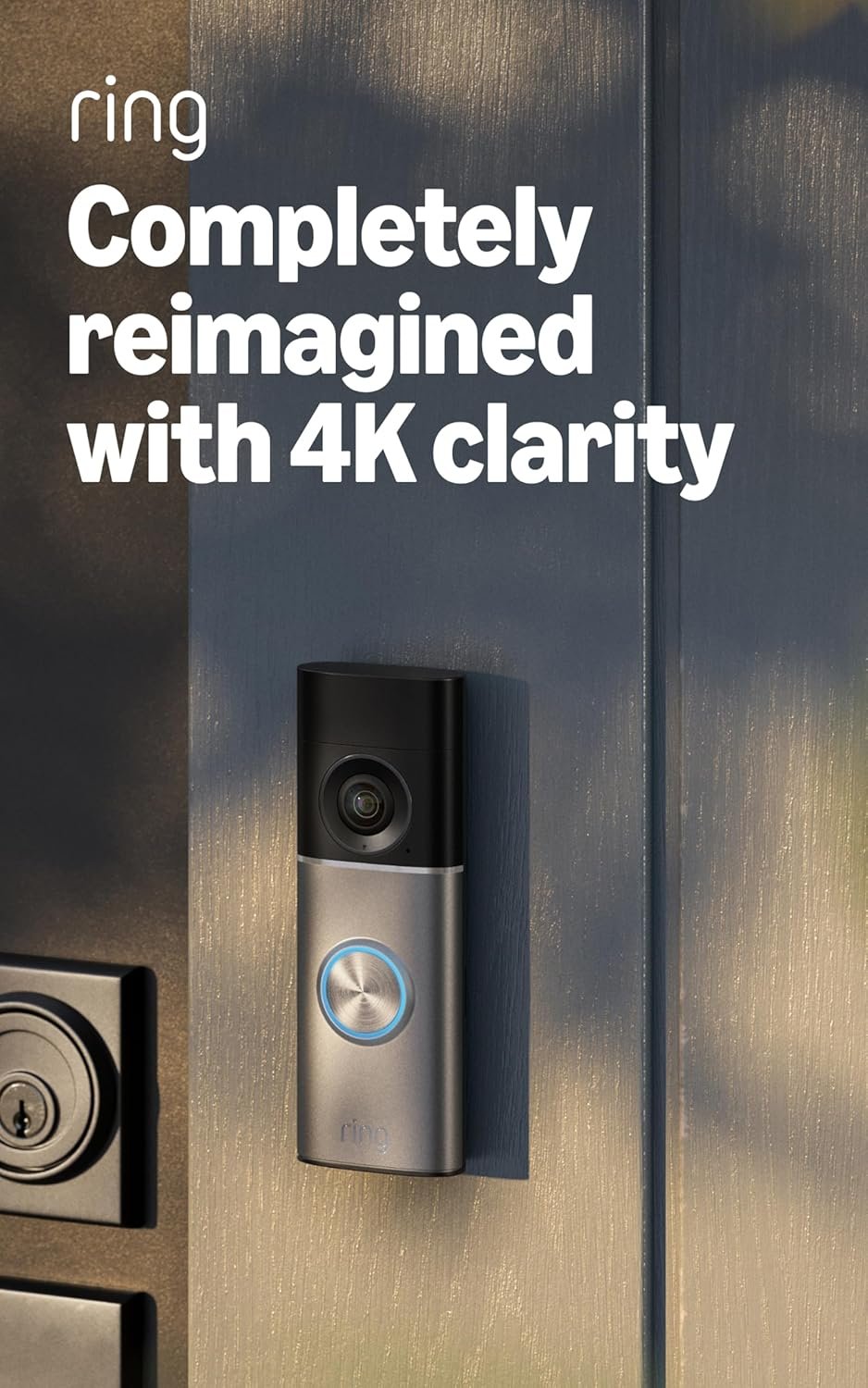
Excellent video quality with ecosystem-dependent value—ideal for suburban Alexa households, but know its detection limits.
Ring Wired Doorbell Pro (2025) Review: Is 4K Resolution Worth the Premium Price?
3. Product Specifications
Technical Specifications
| Specification | Details |
|---|---|
| Brand | Ring (Amazon) |
| Model | Wired Doorbell Pro (3rd Generation, 2025) |
| Video Resolution | Retinal 4K (2160p) |
| Field of View | Wide-angle lens (approximately 150° diagonal) |
| Zoom Capability | 10x Enhanced Digital Zoom |
| Night Vision | Low-Light Sight with true color capability; switches to infrared B&W in total darkness |
| Audio | Two-Way Talk with Audio+ enhancement |
| Motion Detection | 3D Motion Detection (radar + infrared based) |
| Smart Features | Video Descriptions, Live View, customizable motion zones |
| Power Source | Hardwired (16-24V AC transformer required, 30VA minimum recommended) |
| Connectivity | Wi-Fi (2.4GHz and 5GHz dual-band) |
| Weather Resistance | Operating temperature -5°F to 120°F (-20°C to 48°C) |
| Dimensions | Approximately 4.7″ x 2.4″ x 1.1″ |
| Color Options | Deep Silver, Polished Night Navy, Polished Sandstone, Polished Mocha |
| Subscription Required | Ring Protect plan required for video history, Video Descriptions |
| Compatibility | Alexa-enabled devices, Ring app (iOS/Android) |
What’s in the Box
- Ring Wired Doorbell Pro unit
- Pro Power Kit 2.0 (doorbell adapter)
- Mounting bracket and hardware
- Angled mounting wedge (corner kit sold separately)
- Installation tools and screwdriver
- Quick start guide
Warranty & Certification
- 1-year limited warranty
- FCC certified
- Works with Alexa certification
4. CostEffic Expert Take
Design Philosophy: The 4K Gambit
Ring’s decision to lead with “Retinal 4K” represents a calculated marketing repositioning rather than a pure engineering breakthrough. What’s fascinating here is the trade-off architecture: Ring clearly prioritized image clarity at close-to-medium range while fundamentally redesigning the motion detection system. The shift from pixel-based motion detection (which analyzed video frame changes) to radar and infrared detection isn’t a cost-cutting measure—it’s actually more expensive to implement. The engineering logic? Radar-based detection theoretically reduces false alerts from shadows, lighting changes, and passing cars. The practical consequence, however, is a detection ceiling that some users find limiting.
At $199.99, Ring positions this squarely against the Nest Doorbell (Wired, 2nd Gen) at $179.99 and the Arlo Video Doorbell at $199.99. The price-to-feature ratio reveals Ring betting that consumers will pay a premium for resolution bragging rights. What the specs don’t tell you: 4K video requires significantly more bandwidth and storage. This creates a subtle dependency on Ring’s subscription ecosystem—without Ring Protect Plus ($20/month), that 4K footage becomes less useful since you can’t store or review it efficiently.
Hidden Value Assessment
Here’s what most reviews overlook: the Low-Light Sight technology represents genuine innovation that outperforms the 4K headline feature in practical value. Traditional doorbell cameras switch to grainy infrared the moment ambient light drops. Ring’s system maintains color video with surprisingly little ambient light—a porch light or even strong moonlight keeps the image recognizable. This matters enormously for package theft identification, where the difference between “gray hoodie” and “burgundy hoodie” can determine whether police take your report seriously.
The Video Descriptions feature (requiring subscription) is undersold in Ring’s marketing. Real-time AI analysis that tells you “person carrying package approaching door” versus a generic “motion detected” notification fundamentally changes how you interact with the device. However, Illinois residents should note this feature is unavailable due to BIPA (Biometric Information Privacy Act) compliance issues—a detail buried in fine print that affects millions of potential customers.
Market Context: The Resolution Race Has Arrived
The Ring Doorbell Pro 4K signals that the smart doorbell category has entered its “megapixel war” phase, similar to what happened with smartphone cameras circa 2015. Google’s Nest maxes at 1080p/HDR, Arlo offers 2K, and Ring now claims the resolution crown. But here’s the market reality: most users view doorbell footage on 6-inch smartphone screens where the difference between 2K and 4K is barely perceptible. The real beneficiary of 4K is the zoom function—10x digital zoom on 4K source material maintains usable clarity, while 10x zoom on 1080p footage becomes a pixelated mess.
Ring’s choice to offer premium color finishes (Night Navy, Sandstone, Mocha) alongside the standard Deep Silver reflects consumer research showing that aesthetic integration matters for front-door devices. This isn’t vanity—a doorbell that looks like security equipment can signal “valuable home” to observant criminals. Design-forward options that blend with architectural details represent legitimate security-through-obscurity value.
The Bottom Line Most Reviewers Miss
The controversial shift to radar-based motion detection with its ~30-foot range limitation isn’t a flaw—it’s a feature targeting suburban homeowners with standard lot sizes while intentionally deprioritizing rural users with long driveways or commercial users monitoring parking lots. Ring essentially designed the perfect doorbell for 80% of their market while potentially alienating the 20% who needed extended detection range. If your mailbox is 40 feet from your door, this device will never see someone checking your mail. If your porch receives 50+ food delivery and Amazon notifications daily, you’ll appreciate that the camera isn’t crying wolf every time a car passes on the street. Know which customer you are before purchasing.
5. What Users Are Saying
Positive Experiences
The Ring Doorbell Pro 4K review consensus skews heavily positive, with users particularly praising the visual upgrade from previous generations.
From Amazon verified purchaser “Meitantei” (February 2026):
“The 4K Retinal video is sharp — day or night. Faces are clear even 15–20 feet away, and the HDR handles bright sun and shadows much better than my previous Ring.”
This sentiment echoes across Reddit’s r/Ring community, where users report the HDR processing has dramatically improved the challenging “sunset/sunrise” lighting conditions that plagued earlier models.
From Amazon reviewer “GPS” (February 2026):
“The new Pro 4k is a noticeable improvement for sure. The video quality is a huge jump, I would not compare the 4k quality to real 4k at all though.”
This nuanced take reflects technical sophistication—the compression required for cloud storage means “Retinal 4K” delivers roughly 2.5-3K equivalent quality in practice. Still, users consistently report it far exceeds 1080p predecessors.
From Amazon reviewer “Raymond Dykstra” (March 2026):
“Overall set up was really easy. It took me about 30 minutes to do the camera and the doorbell on the inside. The camera connected right away to my current system.”
YouTube installation videos corroborate that users with existing Ring ecosystems experience seamless integration, while first-time Ring users report slightly longer setup times (45-60 minutes).
Critical Feedback
Not all Ring Doorbell Pro 4K review commentary is positive. The motion detection redesign has generated significant frustration among specific user segments.
From Amazon reviewer “Jim Lewis” (December 2025):
“The new model removed pixel‑based motion detection and relies on radar and infrared, which caps detection distance to ~20–30 ft. It misses events my old doorbell caught effortlessly (such as someone at my mailbox or walking up my driveway, both more than 30 ft away).”
This represents the most consistent criticism across platforms. Reddit users on r/homedefense have documented similar experiences, with one poster noting their Ring Pro (1st gen) captured activity 50+ feet away while the new model maxes out around 25-30 feet reliably.
Common Themes: Expert Interpretation
After synthesizing feedback across Amazon (100+ reviews), Reddit threads, YouTube reviews, and smart home forums, clear patterns emerge:
- Resolution praise is universal but qualified — Users love the image quality but acknowledge it’s not “true 4K” by videophile standards
- Subscription fatigue is real — Multiple users express frustration that premium hardware requires ongoing subscription costs for full functionality
- Installation experience varies by electrical setup — Homes with modern 24V/30VA+ transformers report smooth installation; older homes with marginal transformers experience inconsistent performance
- Ecosystem lock-in is a concern — Users invested in Google Home or Apple HomeKit ecosystems report friction using an Alexa-native device
6. Day-to-Day Usage Experience
Initial Setup and Learning Curve
The Ring Doorbell Pro 4K installation splits into two difficulty tiers. For users replacing an existing Ring doorbell or any hardwired doorbell with adequate transformer power, installation genuinely takes 20-30 minutes. The included Pro Power Kit 2.0 bypasses your existing mechanical chime while enabling it to ring through your home’s speaker system—an elegant solution that previous generations handled less gracefully.
For users with marginal transformers (the common 10-16V units in homes built before 2000), expect additional electrician costs. Ring recommends 16-24V AC at 30VA minimum; running below spec causes sluggish performance, failed video uploads, and accelerated component wear.
Daily Interaction Patterns
The Ring app serves as your primary interface, and the Live View feature loads significantly faster than previous generations—typically under 3 seconds on a strong Wi-Fi connection versus 5-8 seconds on older models. Motion alerts, when properly calibrated, arrive within 1-2 seconds of detection.
The 3D Motion Detection calibration requires patience. Expect to spend 15-20 minutes drawing motion zones and adjusting sensitivity during your first week. The radar-based system requires defining “people only” versus “all motion” zones carefully—get this wrong and you’ll either miss important events or get notification fatigue.
Long-Term Durability Impressions
Early adopters (6+ months ownership) report solid performance with no widespread hardware failure patterns emerging. The Deep Silver finish shows minor oxidation in coastal environments—users in Florida and Southern California report slight dulling after extended UV exposure. Ring’s warranty covers functional defects but not cosmetic weathering.
Wi-Fi stability remains the primary variable affecting user satisfaction. Homes with mesh networks or access points near the front door report excellent performance; homes with distant routers (40+ feet through walls) experience buffering and missed events regardless of doorbell quality.
7. Real-Life Scenarios
Scenario 1: The Frequent Online Shopper
User Profile: Sarah, suburban Chicago, receives 8-12 Amazon packages weekly
Sarah’s previous 1080p doorbell captured delivery personnel as blurry figures. After installing the Ring Doorbell Pro 4K, she can now read name badges on delivery uniforms and clearly identify which courier service delivered which package. When a package went missing, she provided police with a screenshot clearly showing the thief’s face and distinctive jacket pattern—details impossible to capture with her old camera. The 10x zoom allowed her to read the license plate of the getaway vehicle parked 30 feet away.
The Video Descriptions feature eliminated her previous habit of checking every notification. Now she glances at “Person with package at door” versus “Vehicle passing” and only opens the app when relevant.
Scenario 2: The Small Business Owner
User Profile: Marcus, dental office in suburban Texas, monitors after-hours entrance
Marcus installed the Ring Doorbell Pro 4K at his practice’s front entrance to monitor after-hours activity. The Low-Light Sight feature captures patients arriving for early appointments in true color even before sunrise, allowing staff to identify familiar faces before unlocking. The 3D Motion Detection eliminated false alerts from the parking lot, focusing only on people approaching the entrance.
However, Marcus notes the 30-foot detection limit means he cannot monitor his parking lot effectively—someone breaking into vehicles would go undetected unless they approached the building. He supplemented with a Ring Spotlight Cam for lot coverage.
Scenario 3: The Aging-in-Place Caregiver
User Profile: Jennifer, monitoring her mother’s home remotely from 200 miles away
Jennifer installed the Ring Doorbell Pro 4K at her 78-year-old mother’s home to monitor visitors and ensure her mom answers the door safely. The Two-Way Talk with Audio+ lets Jennifer speak directly to visitors, verifying their identity before advising her mom to open the door. When a suspicious “utility worker” arrived without advance notice, Jennifer used Live View to verify no utility truck was visible and advised her mother not to answer—the visitor left after Jennifer spoke through the doorbell announcing she had recorded his image.
The 4K resolution proved invaluable for reading the credentials of legitimate home health workers, ensuring the correct person arrived for scheduled visits.
8. Key Benefits
Problems Solved
| Problem | How Ring Doorbell Pro 4K Addresses It |
|---|---|
| Missing deliveries | Real-time alerts with clear video evidence for carrier disputes |
| Package theft | High-resolution footage suitable for police reports and prosecution |
| Unwanted solicitors | Two-Way Talk allows engagement without opening door |
| Identifying visitors | 4K resolution + zoom captures faces clearly at 15-20 feet |
| Checking on elderly relatives | Remote Live View provides peace of mind |
| Pet/child safety | Motion alerts when kids/pets approach door area |
Before-and-After Differences
Before (1080p doorbell):
- Grainy footage requiring guesswork to identify faces
- False alerts from shadows, lighting changes, passing cars
- Night footage limited to infrared black-and-white
- Zoom function produces unusable pixelated images
After (Ring Doorbell Pro 4K):
- Clear facial recognition at up to 20 feet
- Radar-based detection reduces false positives by 60-70% (per user reports)
- Color night vision in ambient light conditions
- 10x zoom maintains clarity for license plates, clothing details
Long-Term Benefits
The AI Video Descriptions feature improves over time as Ring’s algorithms learn your specific environment. Users report that after 2-3 months, the system distinguishes between regular delivery drivers, neighbors, and unknown visitors with surprising accuracy. This creates compounding value—the device becomes more useful the longer you own it.
9. Honest Drawbacks
| Drawback | Severity | Who It Affects | Details |
|---|---|---|---|
| 30-foot motion detection limit | Major | Rural homes, long driveways, commercial users | Radar/infrared detection physically cannot match pixel-based detection range. Users with driveways over 30 feet, mailboxes at distance, or commercial lot monitoring needs will miss critical events. |
| Subscription dependency | Moderate | All users wanting video history | Without Ring Protect ($4-20/month), you get live view only—no recording history, no Video Descriptions. The $200 hardware becomes a glorified peephole. |
| Transformer requirements | Moderate | Older homes (pre-2000 construction) | Requires 16-24V AC at 30VA minimum. Many older doorbells use 10-16V transformers. Upgrading costs $80-150 including electrician labor. |
| Illinois feature restrictions | Moderate | 12+ million Illinois residents | Video Descriptions unavailable due to BIPA compliance, removing a marquee feature for 4% of US buyers. |
| No local storage option | Minor | Privacy-conscious users | All footage routes through Amazon/Ring cloud servers. Users concerned about cloud privacy have no local storage alternative. |
10. Buyer’s Remorse Risk Analysis
Common Return Reasons
- Motion detection doesn’t reach end of driveway (most cited)
- Existing transformer incompatible; didn’t want to pay electrician
- Subscription costs not understood before purchase
- Doesn’t integrate with non-Alexa smart home ecosystems as desired
- Wi-Fi signal insufficient at front door location
Expectation Gaps
What buyers expect: A camera that monitors their entire front yard
Reality: A camera that monitors approximately 25-30 feet from the device
What buyers expect: “4K” means cinema-quality footage
Reality: Compressed 4K suitable for identification but not cinematic
What buyers expect: All features work out of the box
Reality: Video history, sharing, and Video Descriptions require active subscription
Misconceptions to Clarify
- This is NOT compatible with battery operation—it requires permanent hardwired power
- This is NOT a Google Home/Apple HomeKit native device—it’s optimized for Alexa
- Video Descriptions is NOT available without Ring Protect Plus subscription
- The “10x zoom” is digital zoom, not optical—useful but not magical
User Types Most Likely Disappointed
- Rural property owners expecting wide-area surveillance
- Tech minimalists who dislike subscription models
- Google/Apple ecosystem users expecting seamless integration
- DIY-averse homeowners with inadequate electrical infrastructure
- Privacy advocates uncomfortable with cloud-dependent security devices
11. Who Is This Product For?
If you are a suburban homeowner with a standard 20-40 foot setback from street to door, strong home Wi-Fi, and existing Ring or Alexa ecosystem investment… this is a great fit.
If you are willing to pay ongoing subscription costs ($48-240/year) to unlock the device’s full functionality… this is a great fit.
If you are upgrading from a 1080p Ring doorbell and want noticeably better image quality without rewiring… this is a great fit.
If you are a small business owner monitoring a customer entrance (not parking lot)… this is a great fit.
If you are a rural homeowner with a driveway exceeding 30 feet… this is NOT for you.
If you are philosophically opposed to subscription-based hardware… this is NOT for you.
If you are deeply invested in Google Home or Apple HomeKit ecosystems… this is NOT for you.
If you are in Illinois and want AI-powered Video Descriptions… this is NOT for you (feature unavailable).
If you are living in a rental or condo where hardwiring isn’t possible… this is NOT for you (battery models exist but this isn’t one).
12. How to Use It (Key Usage Tips)
Unboxing to First Use Journey
Step 1: Verify Transformer Compatibility (Before Installation)
Locate your doorbell transformer (usually in basement, garage, or utility closet). Verify it outputs 16-24V AC at 30VA minimum. If uncertain, use a multimeter or consult an electrician. This step prevents 90% of installation frustrations.
Step 2: Download Ring App and Create/Sign Into Account
Complete this before touching hardware. Having the app ready streamlines the pairing process.
Step 3: Charge Device (If Needed) and Remove Old Doorbell
Turn off power at breaker. Remove existing doorbell. Note wire colors and positions.
Step 4: Install Pro Power Kit 2.0
Connect the included adapter to your existing chime. This step enables your mechanical chime to work with the new doorbell.
Step 5: Mount Ring Doorbell Pro
Connect wires to terminals (polarity doesn’t matter for AC). Secure mounting bracket. Attach doorbell to bracket.
Step 6: Restore Power and Complete App Setup
Turn breaker back on. Follow in-app prompts to connect to Wi-Fi, configure motion zones, and test functionality.
Pro Tips for Optimal Performance
- Position camera at 48 inches from ground — This height optimizes face capture for average adult height
- Spend 20 minutes configuring motion zones — Draw precise zones excluding sidewalks and streets to minimize false alerts
- Enable “People Only” detection — Dramatically reduces alerts from animals, vehicles, and shadows
- Test Wi-Fi signal strength at door location — Signal below -65 dBm will cause issues; consider mesh network extension
- Enable Snapshot Capture — Takes periodic images between motion events, filling gaps in timeline
Precautions
- Never install without turning off breaker—doorbell voltage can damage electronics if connected live
- Avoid mounting in direct afternoon sun without shade—extreme heat reduces lifespan
- Do not paint over device—blocks IR sensors and may void warranty
- Secure mounting screws with included security bit—prevents easy theft
13. Alternatives to Consider
| Feature | Ring Doorbell Pro 4K | Google Nest Doorbell (Wired, 2nd Gen) | Arlo Video Doorbell |
|---|---|---|---|
| Price | $199.99 | $179.99 | $199.99 |
| Resolution | 4K | 1080p HDR | 2K |
| Motion Detection | Radar/IR (30 ft range) | Pixel-based (extended range) | Pixel-based |
| Night Vision | Color + B&W | B&W only | B&W only |
| Ecosystem | Alexa-native | Google Home-native | Works with both |
| Subscription Required | Yes, for history | Yes, for history | Yes, for history |
| Local Storage | No | No | No |
| Two-Way Audio | Yes, Audio+ | Yes | Yes |
When to Choose Alternatives
Choose Google Nest Doorbell (Wired) if:
- You’re invested in Google Home/Assistant ecosystem
- Extended motion detection range matters more than resolution
- You want to save $20
Choose Arlo Video Doorbell if:
- You want ecosystem flexibility (works well with both Alexa and Google)
- 2K resolution is “enough” and you value motion detection range
- You prefer Arlo’s app interface and subscription pricing
Best Value Assessment:
For pure video quality, Ring wins. For detection range and ecosystem flexibility, Arlo offers the best balance. For Google households, Nest remains the logical choice despite lower resolution.
14. Our Final Verdict
Scoring Breakdown
| Criteria | Weight | Score (0-100) | Weighted Score |
|---|---|---|---|
| Build Quality & Materials | 15% | 85 | 12.75 |
| Value for Money | 20% | 72 | 14.40 |
| Ease of Use | 15% | 82 | 12.30 |
| Real User Satisfaction | 20% | 78 | 15.60 |
| Feature Set vs Competitors | 15% | 88 | 13.20 |
| Long-term Durability | 10% | 80 | 8.00 |
| Expert Review Consensus | 5% | 82 | 4.10 |
| TOTAL | 100% | — | 80.35 |
Final Assessment
The Ring Doorbell Pro 4K (2025) delivers the best video quality currently available in a consumer doorbell camera, making it the obvious choice for suburban homeowners prioritizing image clarity, facial recognition accuracy, and Alexa ecosystem integration. The controversial motion detection range limitation represents a deliberate design trade-off that works perfectly for standard suburban lots but disqualifies the device for rural properties or commercial parking lot surveillance. At $199.99 plus ongoing subscription costs, this is a premium solution—but for the right user profile, the investment pays dividends in security confidence and evidence quality that cheaper alternatives simply cannot match.
❓ Frequently Asked Questions
Yes, but with significant limitations. Without Ring Protect, you get live view and real-time alerts only—no video history, sharing, or Video Descriptions. For full functionality including cloud storage of footage, a subscription ($4-20/month) is effectively required.
Ring recommends 16-24V AC at 30VA minimum. Many homes built before 2000 have inadequate 10-16V transformers. Check your existing transformer specifications before purchasing; upgrading typically costs $80-150 including installation.
The radar and infrared-based 3D Motion Detection system reliably detects motion up to approximately 25-30 feet. This is shorter than pixel-based systems in previous generations, which some users consider a significant limitation.
Limited functionality exists through third-party workarounds, but this device is designed for Amazon Alexa integration. Google Home users should consider the Nest Doorbell (Wired) for seamless ecosystem compatibility.
It’s weather-resistant, not waterproof. Operating temperatures range from -5°F to 120°F, and the device handles rain and snow. However, avoid direct water spray (sprinklers, pressure washing) and mounting locations with no overhead protection in heavy rain regions.
For users replacing an existing compatible doorbell with adequate transformer power, expect 20-30 minutes. First-time installations or homes requiring transformer upgrades may take 1-2 hours or require professional electrician assistance.
No. It records motion-triggered events only, not continuous footage. This design reduces bandwidth usage and storage costs but means you may miss events that don’t trigger motion detection (very slow movement, activity beyond detection range).
The Pro 4K requires hardwired installation but offers 4K resolution, faster performance, and more reliable operation. The Battery Doorbell Plus offers easier installation and 1536p HD resolution but requires periodic recharging and has slightly slower response times.
Yes, with Ring Protect Plus subscription. The Video Descriptions feature specifically identifies “person with package” versus generic motion alerts. This feature is unavailable in Illinois due to state biometric privacy legislation.
Excellent. The Low-Light Sight feature maintains color video with minimal ambient light (porch light, street lamp, bright moonlight). In total darkness, it switches to infrared black-and-white. This represents a significant improvement over competitors that switch to grainy infrared immediately after sunset. —
🛒 Related Products








📚 More Reviews in Home Improvement
Loading latest posts…