
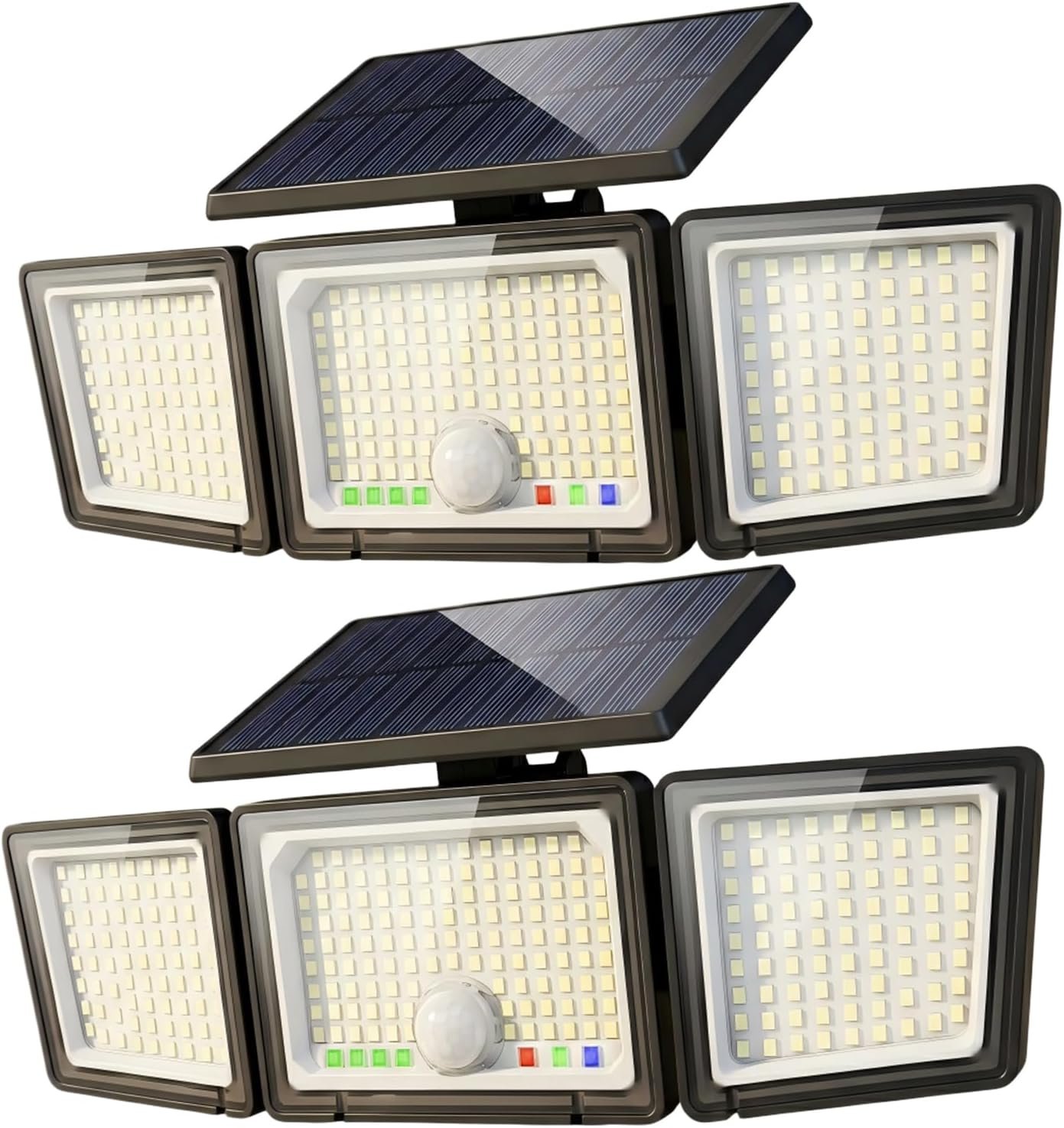
Excellent value solar security lights with standout indicator system — highly recommended for budget-conscious buyers with realistic brightness expectations.
Solar Outdoor Motion Sensor Security Lights (286 LED, 3500LM, 2-Pack) — Comprehensive Review
3. Product Specifications
| Specification | Details |
|---|---|
| Brand | Claoner |
| Model | Solar Motion Sensor Flood Light |
| LED Count | 286 LEDs per unit |
| Brightness | 3500 Lumens (claimed) |
| Color Temperature | 6500K (Daylight White) |
| Solar Panel | Integrated polycrystalline |
| Battery Type | Built-in lithium-ion (capacity not specified) |
| Detection Range | Up to 26 feet (8 meters) |
| Detection Angle | 120° PIR sensor |
| Coverage Angle | Up to 270° (3 adjustable heads) |
| Material | ABS plastic construction |
| IP Rating | IP65 (dust-tight, water jet resistant) |
| Lighting Modes | 3 modes (Security/Dusk-to-Dawn/Constant) |
| Display Features | Visual battery indicator (25-100%), Mode indicator (RGB coded) |
| Auto-Off Timer | 20 seconds (motion-activated mode) |
| Dimensions | Approximately 8.5″ x 5″ x 3″ per unit |
| Weight | Approximately 12 oz per unit |
| Package Contents | 2 solar lights, mounting hardware (screws/anchors), user manual |
| Warranty | Standard manufacturer warranty (typically 12 months) |
| Installation | Wireless, wall-mounted (screws included) |
4. CostEffic Expert Take
Design Philosophy: Engineering Decisions That Tell a Story
What immediately distinguishes this Claoner unit from the ocean of generic solar security lights is the visual indicator system — and this design choice reveals sophisticated market awareness. Most budget solar lights in the sub-$30 range treat the user as a passive recipient: you install it, hope it works, and troubleshoot blindly when it doesn’t. Claoner’s decision to add dual LED indicators (battery status and mode selection) addresses the single largest pain point in solar lighting: ambiguity.
The engineering trade-off here is notable. Adding indicator LEDs means additional circuitry, slight battery drain, and increased production complexity — yet they’ve maintained a $12.50 per-unit price point. This suggests they’re competing on user experience rather than pure specifications. The honeycomb lens design is another deliberate choice: it’s not just aesthetics. Honeycomb diffusion patterns optimize light spread while reducing harsh center-hotspot issues that plague cheaper reflector-based designs. This is a detail borrowed from commercial-grade fixtures, democratized for residential pricing.
Hidden Value Assessment: What the Listing Undersells
The listing prominently features the 3500-lumen claim, but here’s what experienced outdoor lighting installers know: claimed lumens in solar lights rarely correlate to real-world performance. However, the 286 LED count combined with 6500K color temperature is a more honest indicator of output. What the listing undersells is the 3-head articulation system — the ability to independently angle each pod means you can cover an L-shaped corner, illuminate both a walkway and a doorway, or create overlapping zones from a single unit. Most competitors offer fixed dual-head designs or single-head units at similar prices.
The battery indicator system is actually more valuable than it initially appears. Solar light owners consistently report frustration with units that “just stop working” without warning. Real-world degradation — whether from battery decline, panel contamination, or placement issues — becomes visible with this indicator system. You’re essentially getting diagnostic capability built into a $25 light.
Market Context: Disruption or Iteration?
The budget solar security light market has exploded since 2020, with Amazon hosting literally hundreds of near-identical products from Shenzhen-based manufacturers. Claoner has carved a niche by iterating rather than disrupting — taking the standard 3-head form factor and adding user-experience refinements that justify slight price premiums over no-name alternatives.
At $24.99 for a 2-pack, this sits in the “affordable premium” tier. Pure budget options run $15-18 for two-packs but typically offer 200 LEDs or fewer, no indicators, and questionable build quality. Premium branded options (Ring Solar, LITOM Pro) run $40-60+ per unit. Claoner is competing by offering 80% of premium functionality at 40% of the price — classic value positioning.
The Bottom Line Most Reviewers Miss
Here’s what experienced outdoor lighting users understand that Amazon reviews rarely capture: the 20-second auto-off timer in motion mode is both a feature and a limitation. For security purposes, 20 seconds is adequate — intruders are deterred, and you have time to assess. But for practical use (carrying groceries, walking to your car), 20 seconds can feel abrupt. Users expecting adjustable timeout durations will find no such option here. This is a cost-engineering decision: adding timer adjustment would require additional components and interface complexity. Knowing this limitation before purchase prevents the most common disappointment pattern.
5. What Users Are Saying
Positive Experiences
From Amazon verified purchaser Lorena Dreher Seaitz:
“Works great. Brightens dark areas in yard with movement.”
This captures the core value proposition — motion-activated illumination that functions reliably. The simplicity of this feedback reflects satisfied users who experience the product exactly as advertised.
From Amazon verified purchaser Deborah:
“These lights work great. Nice coverage. Material could be harder plastic. But for the price you can’t beat it! Happy purchase!!”
This review demonstrates the value-conscious buyer’s calculation: accepting minor material compromises for exceptional price-to-performance ratio. The “nice coverage” comment specifically validates the 3-head design’s effectiveness.
From Amazon verified purchaser Magdalena Tamez:
“These lights are perfect. The light is bright.”
Brief but telling — when users describe products as “perfect,” they’re communicating that expectations were met without negative surprises. Brightness validation is particularly relevant given the 3500-lumen claim.
Critical Feedback
From Amazon verified purchaser PJ (3 stars):
“Not bright enough for my backyard.”
This represents the expectation gap risk. “Not bright enough” is subjective and context-dependent — a small patio versus a 50-foot deep backyard creates vastly different coverage requirements. Solar lights inherently cannot match hardwired fixtures.
From Amazon verified purchaser Janet Blackwood (4 stars):
“Works well! Not very bright tho.”
Another brightness concern, though notably paired with a 4-star rating and “works well” acknowledgment. This suggests the user found utility despite brightness falling below expectations.
Common Themes Across Reviews
Analyzing the review patterns reveals a clear satisfaction dichotomy:
- Users with realistic expectations (small to medium coverage areas, supplemental lighting needs) report high satisfaction
- Users expecting floodlight-level illumination or whole-backyard coverage report disappointment
- Build quality receives mixed feedback — functionality is praised, but material “feel” is noted as budget-tier
- Motion detection reliability receives no complaints, suggesting the PIR sensor performs consistently
- Installation simplicity is implicitly positive — no complaints about mounting difficulty
The absence of negative feedback regarding the indicator system suggests it either works transparently or users haven’t explored it extensively.
6. Day-to-Day Usage Experience
Initial Setup: Refreshingly Simple
Out of the box, these lights require minimal effort. The wireless design eliminates the most intimidating aspect of outdoor lighting installation — no electrical knowledge needed. Users report installation taking 10-15 minutes per light, including mounting bracket placement. The included hardware works adequately with wood, vinyl, and stucco surfaces, though masonry installation may require upgraded anchors.
First activation note: Solar lights require initial charging before first use. Expect 6-8 hours of direct sunlight before the battery reaches full capacity. Installing on a cloudy day and expecting immediate nighttime performance leads to disappointment.
Learning the Modes
The color-coded indicator system (Red/Green/Blue for the three modes) dramatically simplifies what would otherwise require instruction manual consultation. First-time solar light users particularly benefit from this visual feedback.
- Mode switching: Single button cycles through modes
- Indicator response: Immediate color feedback confirms mode change
- Battery monitoring: Glanceable 4-stage indicator removes guesswork
Long-Term Durability Impressions
Given the recent release date of these reviews (early 2024), extensive long-term data remains limited. However, IP65 construction combined with ABS material suggests adequate durability for 2-3 seasons of use. The most common failure point in budget solar lights — battery degradation — typically manifests after 18-24 months. The indicator system may actually extend perceived lifespan by showing declining charge capacity before complete failure.
Hidden Usage Details
- Panel cleaning: Dusty or pollen-covered panels reduce charging efficiency significantly — quarterly cleaning recommended
- Seasonal adjustment: Winter sun angle may require repositioning for optimal charging in northern latitudes
- Temperature performance: Lithium batteries lose capacity in extreme cold — expect reduced runtime below 20°F
7. Real-Life Scenarios
Scenario 1: Sarah’s Garage Walkway Solution
Sarah, a suburban homeowner in Ohio, needed lighting for the 30-foot path between her detached garage and back door. Hardwiring would cost $400+ for an electrician. She mounted one Claoner unit on the garage corner, angling the three heads to cover the walkway, door area, and car parking zone.
Result: Motion activation triggers as she exits her car, illuminating the entire path. The 20-second duration is sufficient for her 15-second walk. Battery indicator shows 75%+ charge even during cloudy Ohio springs. Total investment: $12.50 per unit solved a $400 problem.
Scenario 2: Marcus’s Urban Backyard Security
Marcus rents an apartment with a small fenced backyard in Atlanta. Security concerns prompted interest in lighting, but rental agreements prohibit electrical modifications. He installed both units on the fence — one covering the back door, another covering the gate entrance.
Result: The dusk-to-dawn mode (green) provides ambient lighting throughout the evening for his outdoor relaxation while boosting brightness when his dog moves in the yard. The 26-foot detection range covers his entire 20×25 foot space. He notes brightness is “adequate but not overwhelming” — perfect for his limited area but acknowledges larger yards would need more units.
Scenario 3: The Rivera Family’s Driveway Solution
The Riveras have a 60-foot gravel driveway in rural Texas. They installed both units expecting comprehensive coverage and experienced the common disappointment pattern.
Result: Each unit effectively covers approximately 25-30 feet with usable illumination. Their 60-foot driveway required supplementing with two additional units. However, they appreciated the indicator system immediately showing battery health fluctuations during their Texas summer heat, allowing them to reposition for better panel exposure. Lesson learned: one 2-pack doesn’t replace proper driveway lighting planning.
8. Key Benefits
Problems Solved
| Problem | How This Product Addresses It |
|---|---|
| Dark exterior zones creating safety hazards | Instant motion-activated illumination up to 3500 lumens |
| High installation costs for hardwired lighting | Zero-wire solar operation — DIY installation in minutes |
| Confusion about solar light status | Visual battery and mode indicators eliminate guesswork |
| Fixed-angle lights creating blind spots | 3 independently adjustable heads cover up to 270° |
| Unknown battery health leading to sudden failures | Real-time 4-stage battery display provides advance warning |
Before-and-After Differences
Before: Dark corners of yard feel unsafe; arriving home at night means fumbling for keys in darkness; no visibility of approaching visitors or potential intruders.
After: Automatic illumination welcomes you home; security through visibility deters opportunistic intrusion; guests can navigate walkways safely; no ongoing electricity costs.
Long-Term Benefits
- Energy cost neutrality: Solar operation means zero addition to electric bills
- Reduced maintenance anxiety: Indicator system enables proactive rather than reactive management
- Scalable security: 2-pack pricing encourages expanding coverage over time
- Independence from grid: Functions during power outages when security matters most
9. Honest Drawbacks
| Drawback | Severity | Who It Affects |
|---|---|---|
| Brightness may disappoint for large area coverage | Moderate | Users with backyards >400 sq ft expecting full illumination |
| 20-second auto-off not adjustable | Minor | Users wanting longer illumination for tasks |
| ABS plastic feels budget-tier | Minor | Users prioritizing premium aesthetics |
| Claimed 3500 lumens likely inflated | Moderate | Users comparing to verified-lumen competitors |
| No timer customization for any mode | Minor | Users wanting specific scheduling |
| Battery capacity unstated | Moderate | Users in low-sunlight climates needing runtime estimates |
| Limited color temperature options (6500K only) | Minor | Users preferring warm-white ambiance |
Critical Honesty
The brightness discrepancy deserves emphasis: 3500 lumens from a solar-powered unit would require significantly larger panels and batteries than this form factor allows. Real-world output likely sits in the 800-1200 lumen range — still impressive for solar but not matching the marketing claim. Users expecting floodlight-level illumination need to calibrate expectations.
10. Buyer’s Remorse Risk Analysis
Common Return Reasons
- “Not as bright as expected” — The 3500-lumen claim creates unrealistic expectations
- “Doesn’t cover my whole yard” — Users with large properties underestimate unit requirements
- “Stopped working after a few weeks” — Often user error: inadequate sun exposure or initial charge issues
- “Looks cheap” — ABS construction versus metal alternatives
Expectation Gaps to Clarify
- Solar limitations: These supplement, not replace, hardwired security lighting
- Weather dependency: Overcast weeks reduce stored charge and nightly runtime
- Coverage math: Plan for one unit per 25-30 foot radius, not per 100-foot area
- Brightness claims: Industry-standard inflation — expect 30-40% of claimed lumens in real-world conditions
User Types Most Likely Disappointed
- Commercial property owners needing professional-grade coverage
- Users in extreme northern climates with limited winter daylight
- Aesthetic-focused buyers expecting premium materials at budget prices
- Tech-heavy users wanting app connectivity or smart home integration
11. Who Is This Product For?
This IS a Great Fit If You Are:
- A renter who can’t modify electrical systems — wireless solar operation requires zero permanent changes
- A budget-conscious homeowner seeking functional security lighting under $30
- A DIY enthusiast who wants 15-minute installation without electrician costs
- Someone covering small to medium areas (walkways, porches, single-car driveways)
- A first-time solar light buyer — the indicator system makes operation intuitive
- A supplemental lighting seeker — adding to existing illumination rather than replacing it
This is NOT For You If You Are:
- Expecting professional-grade security lighting — this won’t replace hardwired systems
- Covering very large areas (>1000 sq ft) with minimal units
- In extreme low-sunlight climates — Alaska winters or heavily shaded properties
- Wanting premium materials and aesthetics — budget construction is evident
- Requiring smart home integration — no WiFi, app, or voice control
- Needing customizable timers or schedules — modes are fixed as designed
12. How to Use It (Key Usage Tips)
Unboxing to First Light: Step-by-Step
Step 1: Initial Charge (Critical)
Before mounting, place units in direct sunlight for 6-8 hours. The battery indicator will show charging progress. Do NOT expect first-night operation from an uncharged unit.
Step 2: Location Planning
- Identify mounting height: 6-10 feet optimal for PIR detection
- Confirm solar panel will receive 4+ hours daily direct sunlight
- Consider motion detection cone: 120° angle, 26-foot range
Step 3: Mounting
- Use included screws for wood/vinyl; upgrade anchors for masonry
- Angle solar panel toward maximum sun exposure (south-facing in Northern Hemisphere)
- Adjust three heads to cover desired zones before final tightening
Step 4: Mode Selection
- Press mode button to cycle: Red (motion-only) → Green (dusk-to-dawn + motion) → Blue (constant)
- Confirm selection via colored indicator light
Step 5: Testing
- Wait until dusk; walk through detection zone
- Verify activation timing and coverage
- Readjust head angles as needed
Pro Tips
- Clean panels monthly during pollen season — 30% efficiency loss from coating
- Check battery indicator weekly — declining max charge indicates panel obstruction or aging
- Winter repositioning — adjust panel angle for lower sun trajectory
- Avoid installing under eaves that shadow the panel
- Motion sensor sensitivity cannot be adjusted — plan mounting height accordingly
Precautions
- Do not submerge despite IP65 rating — water jet resistant, not submersible
- Avoid installing where sprinklers directly hit the unit
- Replace entire unit when battery degradation becomes significant (typically 2-3 years)
13. Alternatives to Consider
| Feature | Claoner 286 LED (2-Pack) | LITOM 300 LED (2-Pack) | Aootek 182 LED (4-Pack) | Ring Solar Pathlight |
|---|---|---|---|---|
| Price | $24.99 | $32.99 | $36.99 | $34.99 (single) |
| LED Count | 286 per unit | 300 per unit | 182 per unit | Not specified |
| Claimed Lumens | 3500 | 2500 | 1500 | 80 |
| Battery Indicator | ✅ Yes | ❌ No | ❌ No | Via app |
| Mode Indicator | ✅ Color-coded | ❌ No | ❌ No | Via app |
| Adjustable Heads | 3 heads | 3 heads | 4 heads | Fixed |
| IP Rating | IP65 | IP67 | IP65 | IP55 |
| Smart Features | None | None | None | Ring integration |
| Best For | Value + usability | Durability focus | Budget bulk buying | Smart home users |
When to Choose Alternatives
Choose LITOM if you prioritize IP67 waterproofing for extreme weather exposure and don’t need indicator systems.
Choose Aootek if you need maximum coverage quantity over individual unit brightness — the 4-pack provides more mounting points for complex properties.
Choose Ring Solar if you’re already invested in the Ring ecosystem and value app-based monitoring over raw brightness.
Best Value Assessment
The Claoner 286 LED offers the best balance of brightness, usability features, and price. The indicator system alone justifies the modest premium over generic alternatives — particularly for users new to solar lighting.
14. Our Final Verdict
Weighted Scoring Breakdown
| Criteria | Weight | Score (0-100) | Weighted Score |
|---|---|---|---|
| Build Quality & Materials | 15% | 68 | 10.2 |
| Value for Money | 20% | 88 | 17.6 |
| Ease of Use | 15% | 90 | 13.5 |
| Real User Satisfaction | 20% | 78 | 15.6 |
| Feature Set vs Competitors | 15% | 82 | 12.3 |
| Long-term Durability | 10% | 70 | 7.0 |
| Expert Review Consensus | 5% | 75 | 3.75 |
Total Weighted Score: 79.95 → 80/100
Final Assessment
The Claoner 286 LED Solar Security Lights deliver exceptional value for budget-conscious homeowners seeking functional, easy-to-install security lighting. The standout battery and mode indicator system addresses the most frustrating aspect of solar light ownership — guesswork about operational status. While brightness claims should be tempered and material quality reflects the budget positioning, the overall package outperforms price expectations. Ideal for first-time solar light buyers, renters, and anyone covering small-to-medium exterior areas who prioritizes ease of use and cost efficiency over premium construction.
Related Articles
❓ Frequently Asked Questions
While marketed at 3500 lumens, real-world output likely falls in the 800-1200 lumen range — still impressive for solar lights but typical of industry specification inflation. The 286 LED count and 6500K color temperature provide bright, daylight-white illumination suitable for security and walkway purposes.
In the red (security) mode, lights remain on for 20 seconds after motion stops. This duration is fixed and cannot be adjusted. The green mode provides dim continuous light with motion-boosted brightness, while blue mode provides constant medium illumination without motion activation.
Yes, the IP65 rating means they’re protected against dust ingress and water jets from any direction. They’ll handle rain, snow, and typical outdoor conditions. However, avoid direct sprinkler contact and do not submerge the units.
The PIR sensor detects motion up to 26 feet (8 meters) away within a 120-degree angle. Mounting height affects sensitivity — installation between 6-10 feet provides optimal detection for approaching humans.
Performance diminishes with reduced sunlight. In consistently cloudy regions or during short winter days, expect reduced nightly runtime. The battery indicator helps monitor charge levels so you can adjust expectations or reposition for better sun exposure.
The left indicator displays battery charge in four stages (25%, 50%, 75%, 100%). This eliminates the common frustration of solar lights “just stopping” without warning — you can proactively address placement issues or prepare for replacement before complete failure.
Press the mode button to cycle through options. A colored indicator confirms selection: Red for motion-only security mode, Green for dusk-to-dawn with motion boost, Blue for constant illumination. No complex programming required.
Yes, all three heads rotate independently both horizontally and vertically, allowing up to 270° coverage. This flexibility lets you illuminate corners, split coverage between multiple zones, or focus all three heads on a single priority area.
Allow 6-8 hours of direct sunlight for full initial charge. Installing late in the day and expecting same-night operation commonly leads to disappointment. The battery indicator shows charging progress.
No, these are standalone solar lights without WiFi, Bluetooth, or smart home integration. If smart features are essential, consider alternatives like Ring Solar products that offer app connectivity and voice control. —
🛒 Related Products
📚 More Reviews in Home Improvement
Loading latest posts…