
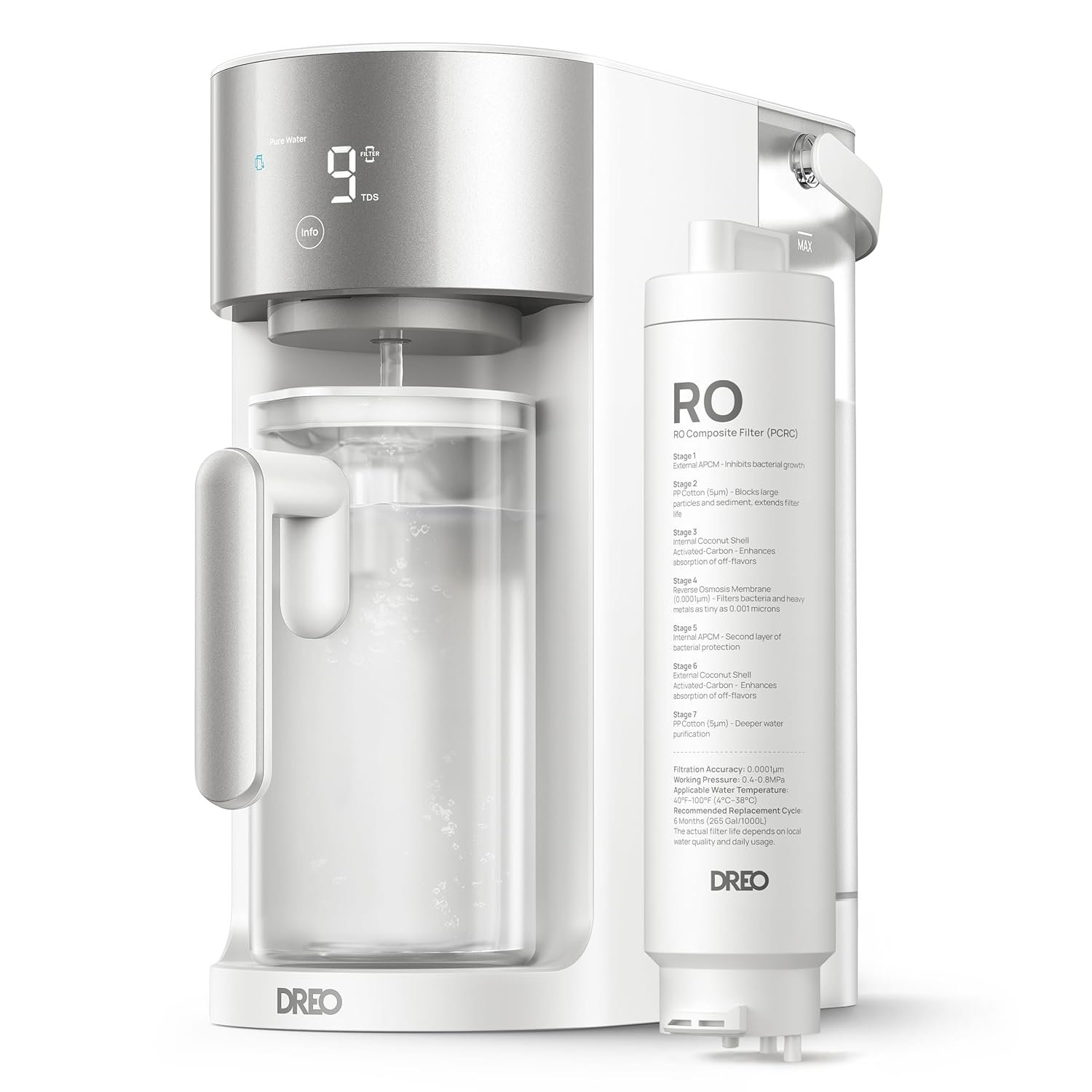
Excellent countertop RO system delivering verified pure water without installation — ideal for renters and small households seeking genuine water quality improvement.
DREO Countertop RO Water Filter Review: The Complete Expert Analysis
3. Product Specifications
| Specification | Details |
|---|---|
| Brand | DREO |
| Model | Countertop RO Filtration System |
| Dimensions | 14.51″ L × 6.73″ W × 13.35″ H |
| Tank Capacity | 3L (internal tank) + 1.1L pitcher |
| Filtration Type | 7-in-1 Reverse Osmosis |
| Pure-to-Drain Ratio | 3:1 |
| Contaminants Removed | 1000+ impurities including PFOA, PFOS, chlorine, fluoride (up to 99.99%) |
| Certification | SGS Tested, meets NSF/ANSI 58 Standards |
| Filter Lifespan | 6-12 months |
| Cost Per Bottle Equivalent | ~$0.025 |
| Display Features | Real-time TDS monitoring, Filter Life indicator |
| Special Features | Auto-fill sensor, Self-cleaning system, Installation-free |
| Power | Electric (plug-in) |
| Target Household Size | 1-2 people |
| Installation Required | None – countertop placement only |
| Recommended Wall Clearance | 12 inches from wall |
| Price | $169.99 |
What’s in the Box:
- DREO RO filtration unit
- 1.1L pitcher with lid
- Pre-installed filter cartridge
- User manual
- Power cord
4. CostEffic Expert Take
Design Philosophy: Engineering a Contradiction
The DREO Countertop RO Filter represents an interesting engineering challenge: how do you deliver true reverse osmosis purification — a technology traditionally requiring under-sink installation and permanent plumbing connections — in a portable, countertop format? The answer lies in some clever compromises that deserve deeper examination.
The 3:1 pure-to-drain ratio is the headline here, and it’s genuinely impressive for the countertop RO category. Traditional under-sink RO systems typically operate at ratios between 1:3 and 1:4 (meaning 3-4 gallons wasted for every gallon of pure water). DREO has essentially flipped this ratio, which required engineering a slower filtration process and optimizing membrane efficiency. This is why the unit takes approximately four minutes to fill the pitcher — speed was deliberately sacrificed for water efficiency. Most buyers don’t realize this trade-off was intentional and represents a significant technical achievement at this price point.
Hidden Value Assessment: The TDS Game-Changer
What the Amazon listing undersells is the dual TDS (Total Dissolved Solids) monitoring system. Having real-time visibility into both your incoming tap water quality AND your filtered output isn’t just a convenience feature — it’s accountability built into the product. In an industry where many “water purification” claims are difficult for consumers to verify, DREO essentially installed a truth meter. This feature alone justifies a premium over pitcher filters that offer no measurable verification of performance.
However, what the listing potentially oversells is the “fits anywhere” convenience. Multiple reviewers note the 12-inch wall clearance requirement buried in the manual, which significantly expands the actual footprint. A 14.5″ deep unit needing 12″ of rear clearance means you’re dedicating over 26 inches of counter depth — that’s nearly half of a standard 24″ countertop, which most buyers don’t anticipate.
Market Context: The Middle-Ground Disruptor
At $169.99, DREO is positioning this unit in a fascinating gap between cheap pitcher filters ($20-50) and premium under-sink RO systems ($300-800+). They’re targeting the renter demographic, apartment dwellers, and anyone who can’t or won’t modify their plumbing — a massive, underserved market segment. The rise of PFAS awareness and water quality concerns post-2020 has created urgent demand that traditional filtration companies have been slow to address.
DREO, known primarily for their fans and air purifiers, is leveraging their expertise in countertop appliance design and bringing it to water filtration. This cross-category expansion is a trend worth watching — companies with strong industrial design DNA entering adjacent markets often outperform legacy players who’ve grown complacent.
The Bottom Line Most Reviewers Miss
Here’s what nobody is talking about: the self-cleaning auto-flush system isn’t just about convenience — it’s about preventing biofilm buildup in the internal tubing, which is the silent killer of countertop water systems. Stagnant water in filtration pathways breeds bacteria, and most countertop units require manual maintenance protocols that users inevitably neglect. DREO’s automated solution addresses a genuine hygiene concern that competing products ignore. The engineering team clearly understood that the best filtration system is worthless if the delivery pathway is contaminated — a nuance that demonstrates serious category expertise.
5. What Users Are Saying
Positive Experiences
On water quality transformation:
“My well water is doable but not fit to drink. Bought this unit. Followed set-up instructions. This RO unit is amazing. Our water now is better than bottled water. This unit will pay for itself in no time with the savings of not having to buy bottle water.” — berten e., Amazon Verified Purchase
On practical everyday use:
“Rarely leave reviews. This is a solid product. I live in an apartment, I was tired of buying/drinking water bottles and I don’t trust Brita. This was the solution, and I’m happy with it. Water tastes great, and so far, machine works really well.” — Patrick C., Amazon Verified Purchase
On specialized applications:
“It’s nice design and easy to use for my daughter’s dorm. We live in hard water state and her cat got urinary blockage so I bought this for her cat too. Taste pure water and nice to have Digital Display for TDS.” — Miisan24, Amazon Verified Purchase
Critical Feedback
On space requirements:
“It does what it is supposed to efficiently… However, I was not aware that this product should be 12 inches away from wall based on the manual. It is compact but requires more space than its actual size.” — Amazon Customer, Verified Purchase
On initial setup nuances:
“After setting up by running the 4 tanks of water, I would suggest running at least a 5th one to get good tasting water. Also, while the system gives continuous TDS readings, the first clear pitcher…” — mla, Amazon Verified Purchase
Common Themes: Expert Interpretation
The review pattern reveals a product that consistently exceeds expectations on its core promise — water quality — while occasionally surprising users with practical considerations. The enthusiasm about taste improvement is nearly universal, suggesting the filtration genuinely performs. The space requirement issue appears in multiple reviews, indicating DREO could improve their pre-purchase communication.
Interestingly, users with specific water challenges (well water, high nitrates, hard water regions) report the strongest satisfaction. This suggests the DREO performs best when solving an acute, noticeable water quality problem rather than serving as a mild upgrade from already-decent municipal water.
The pet health application mentioned by Miisan24 represents an underexplored use case — veterinarians increasingly recommend purified water for pets prone to urinary issues, and the countertop format makes this practical in ways under-sink systems don’t.
6. Day-to-Day Usage Experience
Initial Setup
The unboxing experience receives consistent praise for professional packaging quality — a detail that matters when you’re shipping a unit containing delicate RO membranes. Setup is genuinely installation-free: position the unit, fill the raw water tank, plug it in, and run the initial flush cycles. Most users report being operational within 20-30 minutes, though the full “break-in” period (4-5 tank cycles) takes several hours.
Learning Curve
The DREO system operates on an intuitive fill-and-wait model. The auto-fill sensor automatically triggers filtration when the pitcher is placed correctly, eliminating the need to remember to start the process. The TDS display requires no interpretation training — lower numbers mean cleaner water, and the filter life indicator removes guesswork about replacement timing.
Hidden Usage Details
Users discover several non-obvious realities:
- Filling time: Approximately 4 minutes per pitcher means you need to plan slightly ahead during high-consumption periods
- Noise level: The unit is notably quiet according to multiple reviews — important for apartment living or office placement
- Pitcher capacity trade-off: The 1.1L pitcher is modest for families; savvy users purchase additional pitchers to keep filled in the refrigerator
- Tank refill frequency: For 1-2 person households, refilling the 3L raw water tank once daily is typical
Long-Term Durability Impressions
Given the product’s relatively recent market entry (reviews from early 2026), extended durability data remains limited. However, the build quality comments are uniformly positive — “well built,” “sleek,” “solid” appear repeatedly. The twist-to-install filter replacement mechanism suggests DREO designed for maintainability over the product’s lifetime.
7. Real-Life Scenarios
Scenario 1: The Apartment Renter
Meet Sarah, 28, living in a Chicago studio apartment.
Sarah’s landlord won’t allow any plumbing modifications, and her building’s water has a noticeable chlorine taste that makes her coffee bitter. She was spending $40/month on bottled water and felt guilty about the plastic waste.
After setting up the DREO system on her limited counter space (she positioned it near an outlet on her kitchen’s breakfast bar), Sarah noticed an immediate difference. Her morning pour-over coffee tasted cleaner, and the TDS display showed her tap water dropping from 280 ppm to under 15 ppm after filtration. At $0.025 per bottle equivalent, her first month of use cost roughly $3 in “water production” versus her previous $40 spending. The unit paid for itself within five months.
Scenario 2: The Rural Homeowner
Meet David and Maria, early 40s, living in rural Iowa.
Their well water tested high for nitrates — a common agricultural runoff problem in the Midwest. While a whole-house filtration system quoted at $3,000+ remained on their long-term wishlist, they needed an immediate solution for drinking water, especially with young children in the house.
The DREO unit reduced their TDS readings significantly, and David noted it “lowered nitrate levels a bit” — though RO filtration is more effective at some contaminants than others. They keep the DREO on their kitchen counter for drinking and cooking water while using unfiltered water for washing. The unit’s compact footprint allowed placement under their upper cabinets, preserving workspace.
Scenario 3: The College Parent
Meet Jennifer, whose daughter Emma attends university in a hard-water region.
When Emma’s cat developed urinary blockage — a condition veterinarians increasingly link to mineral-heavy water — Jennifer immediately researched solutions. Under-sink installation wasn’t possible in Emma’s dorm, and hauling bottled water wasn’t practical.
The DREO unit fit perfectly on Emma’s dorm desk (she moved it to her kitchenette area during cooking). The cat now drinks exclusively filtered water, and Emma uses it for her own hydration and coffee-making. The digital TDS display lets Emma verify the water quality, giving Jennifer peace of mind from 500 miles away.
8. Key Benefits
Problems Solved
| Problem | DREO Solution |
|---|---|
| Can’t install under-sink RO system | Zero installation required — plug and pour |
| Uncertainty about filter effectiveness | Real-time TDS display provides measurable proof |
| Water waste from traditional RO | 3:1 pure-to-drain ratio minimizes waste |
| Forgetting filter replacements | Automatic filter life monitoring with alerts |
| Bacterial buildup in water lines | Self-cleaning auto-flush system |
| Buying bottled water | $0.025/bottle equivalent cost |
| PFAS/PFOA water contamination concerns | Removes up to 99.99% of 1000+ contaminants |
Before-and-After Differences
Before DREO:
- Monthly bottled water spending: $30-50+
- Plastic bottle waste: 60-100+ bottles
- Water taste: Chlorine, mineral, or “off” flavors
- Water quality confidence: Low/unknown
- Counter space: Unoccupied
After DREO:
- Monthly water cost: ~$3-5
- Plastic waste: Near zero
- Water taste: “Better than bottled” (per multiple reviews)
- Water quality confidence: Verified by TDS readings
- Counter space: ~26″ deep footprint occupied
Long-Term Benefits
- Health investment: Consistent access to purified water without ongoing effort
- Cost savings: ROI achieved within 4-6 months for most users
- Environmental impact: Significant plastic reduction over product lifetime
- Convenience compound: The easier pure water is to access, the more you drink it
9. Honest Drawbacks
| Drawback | Severity | Who It Affects | Details |
|---|---|---|---|
| 12-inch wall clearance requirement | Moderate | Small kitchen owners, those with limited counter depth | Effectively doubles the depth footprint to ~26″; not clearly communicated pre-purchase |
| Small pitcher capacity (1.1L) | Minor | Families, high-consumption households | Requires frequent refills or purchasing additional pitchers |
| 4-minute fill time | Minor | Impatient users, large gatherings | Not instant gratification; requires slight planning ahead |
| Initial flush requirement | Minor | First-time users | 4-5 tank cycles needed before optimal taste; not instant gratification |
| Nitrate reduction limitations | Moderate | Well water users in agricultural areas | RO reduces but may not eliminate nitrates to desired levels |
| Electricity dependent | Minor | Off-grid users, power outage situations | No manual/gravity option available |
Severity Assessment Context:
- Minor: Inconvenience that’s easily worked around
- Moderate: May affect satisfaction for certain user segments
- Major: Fundamental limitation affecting core function (none identified)
10. Buyer’s Remorse Risk Analysis
Common Return Reasons (Anticipated)
Based on review patterns and product characteristics:
- Space miscalculation: Buyers who didn’t account for the 12-inch rear clearance and find the unit won’t fit their intended location
- Capacity mismatch: Families of 3+ who find the refill frequency excessive for their consumption
- Expectation of instant water: Users comparing to refrigerator dispensers or expecting zero wait time
- Nitrate-specific disappointment: Well water users expecting complete nitrate elimination
Expectation Gaps to Address
| Expectation | Reality |
|---|---|
| “Compact means it fits anywhere” | Requires ~26″ of counter depth including clearance |
| “Works immediately out of box” | 4-5 flush cycles needed for optimal taste |
| “Removes everything” | Highly effective but not 100% on all contaminants |
| “For the whole family” | Optimized for 1-2 person households |
Misconceptions to Clarify
- Not a whole-house solution: This filters drinking water only, not all household water
- Not instant: 4-minute fill time is standard for quality RO filtration
- Requires electricity: Cannot operate during power outages
- Filter replacement is ongoing cost: 6-12 month filter lifecycle means $XX annual maintenance (filter pricing varies)
User Types Most Likely Disappointed
- Large families (4+ people): Capacity and fill speed create friction at scale
- Kitchen minimalists: The footprint is more substantial than it appears
- Zero-maintenance seekers: Filter replacement and tank refilling are unavoidable
- Well water users expecting perfect nitrate removal: RO helps but may not solve severe contamination
11. Who Is This Product For?
Great Fit:
- If you are a renter who can’t install under-sink filtration… this is a great fit.
- If you are a single person or couple seeking bottled water replacement… this is a great fit.
- If you are concerned about PFAS/PFOA or chlorine in municipal water… this is a great fit.
- If you are a college student in a dorm or small apartment… this is a great fit.
- If you are seeking verified, measurable water quality improvement… this is a great fit.
- If you are environmentally conscious about plastic bottle waste… this is a great fit.
Not For You:
- If you are feeding a family of four or more… this is NOT for you. Consider the larger DREO model or an under-sink system.
- If you are expecting instant water on demand… this is NOT for you. Refrigerator dispensers or tankless RO systems may suit better.
- If you are working with extremely limited counter space (under 26″ available depth)… this is NOT for you.
- If you are seeking a complete nitrate elimination solution for severe contamination… this is NOT for you. Consult a water treatment specialist.
- If you are living off-grid without reliable electricity… this is NOT for you.
12. How to Use It (Key Usage Tips)
Unboxing to First Use Journey
Step 1: Unbox Carefully
Remove all packaging materials and inspect the unit. Locate the pre-installed filter cartridge — no separate filter installation needed initially.
Step 2: Position Thoughtfully
Select a location with:
- Electrical outlet access
- At least 12 inches of clearance behind the unit
- Stable, level surface
- Proximity to your water source (sink) for easy tank refilling
Step 3: Initial Flush Protocol
Fill the raw water tank and run 4-5 complete filtration cycles. Discard this water — it flushes manufacturing residue and prepares the membrane. Most users report water tastes optimal after the 5th cycle, not the 4th as some instructions suggest.
Step 4: Verify TDS Readings
Once operational, note your raw water TDS and filtered water TDS. Most users see dramatic drops (e.g., 280 ppm → 15 ppm). This becomes your baseline for monitoring filter performance over time.
Pro Tips from Real Users
- Buy an extra pitcher: Keep one filtering while one chills in the refrigerator
- Establish a refill routine: Fill the raw water tank at a consistent time (morning or evening) to avoid running dry
- Monitor TDS trends: If filtered TDS begins rising, it’s filter replacement time (even before the indicator triggers)
- Run the unit regularly: Stagnant water promotes issues; daily use is ideal
- Clean the pitcher normally: The RO unit self-cleans, but the pitcher benefits from occasional hand washing
Precautions
- Do not operate without water in the raw tank (can damage the pump)
- Place on water-resistant surface to catch any condensation or minor drips
- Replace filters at indicated intervals to maintain purification standards
- Do not use with water above recommended temperature (check manual for specifics)
13. Alternatives to Consider
| Feature | DREO Countertop RO | Waterdrop RO System | AquaTru Countertop RO | Brita UltraMax |
|---|---|---|---|---|
| Price | $169.99 | $199-299 | $399-449 | $47.99 |
| Filtration Type | 7-Stage RO | 4-Stage RO | 4-Stage RO | Carbon Filter |
| TDS Display | Yes (dual) | Yes | Yes | No |
| Pure-to-Drain Ratio | 3:1 | 2:1 to 3:1 | 4:1 | N/A |
| Tank Capacity | 3L + 1.1L pitcher | Varies by model | 3L | 18-cup |
| Installation | None | None | None | None |
| Self-Cleaning | Yes | Model dependent | No | No |
| Certification | NSF/ANSI 58 | NSF/ANSI 58 | NSF/ANSI 58 | NSF/ANSI 42, 53 |
| Best For | Budget-conscious RO seekers | Premium feature seekers | Largest capacity needs | Basic taste improvement |
When to Choose Alternatives
Choose Waterdrop if: You want more model options and don’t mind paying a premium for brand recognition in the water space
Choose AquaTru if: Budget is less constrained and you prioritize established track record and larger capacity
Choose Brita UltraMax if: Your water quality concerns are primarily taste-based (chlorine), not contamination-based, and budget is the primary driver
Best Value Assessment
The DREO offers the strongest value proposition for buyers who:
- Need true RO filtration (not just carbon filtering)
- Want verification through TDS monitoring
- Prioritize water efficiency (3:1 ratio)
- Are working within a ~$150-200 budget
14. Our Final Verdict
Scoring Breakdown
| Criteria | Weight | Score | Weighted |
|---|---|---|---|
| Build Quality & Materials | 15% | 85 | 12.75 |
| Value for Money | 20% | 88 | 17.60 |
| Ease of Use | 15% | 82 | 12.30 |
| Real User Satisfaction | 20% | 87 | 17.40 |
| Feature Set vs Competitors | 15% | 85 | 12.75 |
| Long-term Durability | 10% | 78 | 7.80 |
| Expert Review Consensus | 5% | 83 | 4.15 |
Total Weighted Score: 84.75
Final Assessment
The DREO Countertop RO Water Filter earns our strong recommendation for its target audience: singles, couples, and renters who want true reverse osmosis purification without plumbing modifications. The real-time TDS verification, exceptional 3:1 pure-to-drain efficiency, and self-cleaning functionality represent genuine engineering achievements at a sub-$200 price point. The main caveats — space requirements and modest capacity — are clearly documented for informed decision-making. For anyone currently buying bottled water or relying on basic pitcher filters while worrying about PFAS, fluoride, or other serious contaminants, the DREO represents a meaningful upgrade that pays for itself within months.
❓ Frequently Asked Questions
Yes, the DREO system is SGS tested and meets NSF/ANSI 58 standards, which specifically certifies removal of PFOA, PFOS, and over 1,000 other contaminants at up to 99.99% efficiency. The reverse osmosis membrane is the gold standard technology for PFAS removal in residential water treatment.
Filter lifespan ranges from 6 to 12 months depending on your usage frequency and incoming water quality. The unit includes a filter life monitoring display that provides proactive replacement reminders, eliminating guesswork about timing.
Multiple user reviews describe the unit as notably quiet. The pump operates at a low noise level suitable for apartment living, offices, or even bedroom placement without causing disturbance during filtration cycles.
While the unit measures 14.51″ L × 6.73″ W × 13.35″ H, the manual specifies 12 inches of clearance behind the unit. Plan for approximately 26-27 inches of total counter depth to accommodate proper installation and ventilation.
Yes, the DREO system works with well water and effectively reduces many common well water contaminants. However, users with severe contamination issues (particularly high nitrates in agricultural areas) report partial rather than complete elimination — consult a water quality specialist for severe cases.
Approximately 4 minutes to fill the 1.1L pitcher. This is standard for quality RO filtration — the slower process is an intentional trade-off that enables the efficient 3:1 pure-to-drain water ratio.
The 3:1 ratio means for every 3 liters of purified water produced, only 1 liter goes to drain. Traditional RO systems waste 3-4 liters for every liter purified. DREO’s efficiency significantly reduces water waste and your environmental footprint.
The 3L tank plus 1.1L pitcher is designed for 1-2 person households. Families of four can use the system but may find the refill frequency inconvenient. Consider the larger DREO model or purchasing additional pitchers to keep filled in the refrigerator.
No plumbing or installation is required. Simply place the unit on your counter, fill the raw water tank manually, and plug it into a standard electrical outlet. This makes it ideal for rentals, dorms, and temporary living situations.
The dual TDS (Total Dissolved Solids) display shows both your raw tap water reading and filtered water reading in real-time. Most users see dramatic drops (e.g., 280 ppm to under 20 ppm), providing visual verification that the RO membrane is performing correctly. —
🛒 Related Products
📚 More Reviews in Home Improvement
Loading latest posts…