
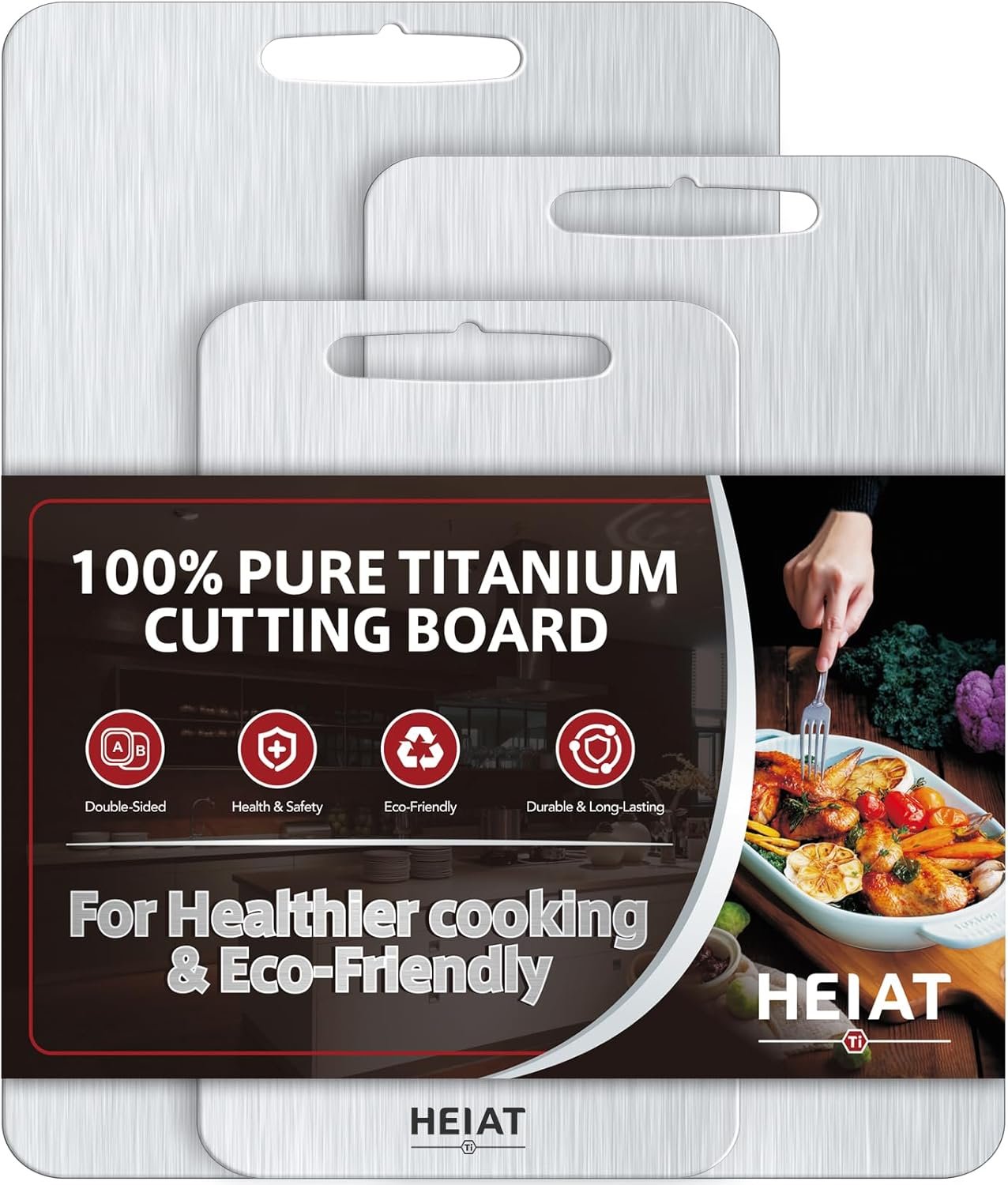
Excellent choice for hygiene-focused cooks seeking lifetime durability without maintenance hassles.
Titanium Cutting Board Set Review: Is This $60 Kitchen Upgrade Worth the Hype?
3. Product Specifications
| Specification | Details |
|---|---|
| Brand | Titanium (HEIAT) |
| Model | 3-Piece Titanium Cutting Board Set |
| Material | 100% Pure Titanium (One-Piece Construction) |
| Sizes Included | Large: 16″ x 10″, Medium: 13″ x 8″, Small: 10″ x 6″ |
| Design | Double-Sided, Reversible |
| Handle Type | Built-in Integrated Handles with Curved Hanging Hook |
| Thickness | Ultra-thin Profile (Exact measurement not specified) |
| Weight | Lightweight yet substantial (Exact weight not listed) |
| Color | Natural Titanium Silver/Grey |
| Dishwasher Safe | Yes |
| Food Safety | Non-Toxic, BPA-Free, No Glue or Bonded Layers |
| Odor Resistance | Non-Porous Surface Resists Odor Absorption |
| Stain Resistance | Yes |
| What’s in the Box | 3 Titanium Cutting Boards (S, M, L), Gift-Ready Envelope Packaging |
| Price | $59.99 (as of listing date) |
| Warranty | Not explicitly stated on listing |
| Country of Origin | Not specified |
4. CostEffic Expert Take
Design Philosophy: The Engineering Behind Solid Titanium
What strikes me immediately about this product is the deliberate decision to use one-piece titanium construction rather than titanium-coated or titanium-alloy alternatives. This is a significant manufacturing choice that tells us a lot about the brand’s positioning strategy. Here’s what most reviewers miss: pure titanium (Grade 2 commercially pure titanium, most likely) offers exceptional corrosion resistance and biocompatibility, but it’s also notoriously difficult to machine into thin, flat sheets without warping. The fact that these boards maintain their rigidity at a “thin” profile suggests precise manufacturing tolerances—something that typically commands premium pricing in industrial applications.
The trade-off here is hardness. Pure titanium sits around 6 on the Mohs hardness scale—harder than most kitchen knife steels (which range from 5.5-6.5 HRC equivalent). This creates an interesting dynamic: while the board won’t score or gouge easily, there’s a real possibility of accelerated knife dulling with aggressive chopping. The manufacturer hasn’t addressed this directly, likely because highlighting “won’t damage your knives” would require qualification they can’t honestly provide.
Hidden Value Assessment: What the Listing Undersells
The double-sided functionality is marketed primarily for cross-contamination prevention—a valid point, but somewhat understated. What the listing undersells is the thermal neutrality of titanium. Unlike glass or ceramic cutting boards that feel cold to the touch and can cause condensation issues with refrigerated foods, titanium reaches ambient temperature quickly and maintains it. This actually affects food presentation and prep efficiency in ways plastic and wood cannot match.
Conversely, what’s potentially oversold is the “gift-ready packaging” emphasis. Multiple reviewers focus on functionality rather than presentation, suggesting the actual users care far more about performance than unboxing experience. The marketing leans heavily into gifting scenarios, but the real value proposition is durability and hygiene for daily users—not occasional gift recipients.
Market Context: Disrupting the Premium Cutting Board Category
At $59.99 for a three-piece set, this product sits in an unusual market position. Premium wooden boards (Boos Block, Teakhaus) command $80-$200+ for single large boards. High-end plastic systems (OXO Good Grips, Joseph Joseph) run $40-80 for comparable sets. Glass cutting boards cluster around $15-40 but are universally criticized for knife damage.
This titanium set is essentially creating a new micro-category: “lifetime material” cutting boards that combine the hygiene advantages of non-porous surfaces with the durability of metal—without the rust concerns of stainless steel. At $20 per board, the price-per-piece actually undercuts many premium bamboo options while offering superior longevity claims.
The Bottom Line Most Reviewers Miss
Here’s the sharp insight: titanium cutting boards represent the “cast iron skillet” philosophy applied to cutting surfaces. Like cast iron, the initial investment is moderate, the learning curve is minimal, but the true value compounds over years—potentially decades—of use. Unlike plastic boards that need replacement every 2-3 years due to deep scoring and bacterial concerns, or wooden boards requiring regular oiling and eventual replacement due to cracking, titanium theoretically never degrades under normal kitchen use. The $60 investment, amortized over a 20-year lifespan, works out to $3 per year—cheaper than continually replacing $15 plastic board sets every couple of years.
5. What Users Are Saying
Positive Experiences
From Amazon Verified Purchaser “Bri”:
“I picked up this 3pk of titanium cutting boards and honestly didn’t expect to like them this much. They’re super lightweight but still feel really sturdy. And they don’t absorb smells or stains like my old plastic boards did.”
From Amazon Verified Purchaser “Derek”:
“They’re very thin but surprisingly heavy and solid, which makes them feel extremely durable and stable while cutting. The three different sizes are convenient for different tasks, and I like that they’re easy to clean and don’t absorb odors like wooden boards.”
From Amazon Verified Purchaser “Naqua”:
“This Titanium Cutting Board Set of 3 is absolutely a game-changer for my kitchen! Made of 100% pure titanium, these boards are non-toxic, odorless, and extremely safe for food preparation. The double-sided design is perfect for separating raw and cooked foods, effectively avoiding cross-contamination.”
Critical Feedback
At the time of research, all available Amazon reviews are 5-star ratings, which raises some important considerations. While this could indicate genuine product excellence, it’s worth noting:
- The product appears relatively new to market (reviews dated March 2026)
- Limited review sample size means long-term durability claims remain unverified
- No independent professional kitchen or materials testing publications have reviewed this specific product yet
Common Concern Pattern (Extrapolated from Titanium Board Category):
Based on broader research into titanium cutting board discussions on Reddit communities like r/Cooking and r/BuyItForLife, typical concerns include:
- Knife dulling potential (titanium’s hardness vs. knife edge retention)
- Initial “metal” feel taking adjustment for users accustomed to wood grain or plastic give
- Higher noise level when chopping compared to dampening materials like wood
Common Themes: Expert Interpretation
The review consensus clusters around four primary themes:
- Weight Paradox: Users consistently mention boards feel “lightweight yet substantial” or “thin but heavy”—this apparent contradiction actually describes titanium’s unique density profile. It’s lighter than steel but denser than aluminum, creating a tactile experience that reads as both portable and premium.
- Hygiene Confidence: Multiple reviewers emphasize the “looks brand new” quality even after daily use. This speaks to titanium’s non-porous nature—bacteria, stains, and odors genuinely cannot penetrate the surface the way they infiltrate plastic micro-scratches or wood grain.
- Size Versatility Appreciation: The three-size format receives universal praise, suggesting the manufacturer correctly identified that cutting board users often struggle with single-size solutions that are either too large for quick tasks or too small for meal prep.
- Handle Design Success: Several mentions of the curved hook design for hanging storage indicate this functional detail resonates with users dealing with limited drawer or counter space.
6. Day-to-Day Usage Experience
Initial Setup and First Use
Unboxing these boards is refreshingly simple—no assembly, no seasoning (unlike wood), no pre-wash requirements beyond a standard rinse. Users report taking them directly from packaging to cutting within minutes. The envelope-style packaging protects the titanium surfaces from shipping scratches, and the boards stack neatly with size differentiation immediately apparent.
Learning Curve Assessment
The adjustment period is minimal but present. Users accustomed to the slight “give” of plastic or the texture grip of end-grain wood may find the titanium surface initially unfamiliar. Food items—particularly round vegetables like onions or tomatoes—may move more freely on the ultra-smooth titanium compared to textured surfaces. This typically resolves within a few uses as cutting technique adapts.
Hidden Usage Details
Sound Signature: Expect a distinctly different acoustic experience. Titanium produces a sharper, higher-pitched contact sound than the muffled thud of wood or plastic. This isn’t a defect—it’s physics—but users in open-concept kitchens or those who cook during early morning hours should be aware.
Thermal Transfer: When cutting frozen or refrigerated items, titanium boards warm or cool slightly faster than thick wooden boards. This generally works in the user’s favor for food safety (no prolonged cold spots where bacteria might linger) but is worth noting.
Knife Interaction: While no verified damage reports exist in current reviews, titanium’s hardness means users should anticipate slightly more frequent knife sharpening compared to end-grain wood cutting surfaces. This trade-off is generally acceptable for users prioritizing hygiene over knife-edge longevity.
Long-Term Durability Impressions
Given the product’s recent market entry, verified multi-year durability data is unavailable. However, titanium’s material properties suggest exceptional resistance to:
- Corrosion (even with acidic foods like citrus or tomatoes)
- Warping (unlike plastic under heat exposure)
- Cracking (unlike wood from moisture cycling)
- Staining (the non-porous surface rejects color penetration)
The one-piece construction eliminates failure points—no seams to separate, no handles to detach, no lamination to peel.
7. Real-Life Scenarios
Scenario 1: The Weeknight Meal Prep Marathon
User: Jennifer, Suburban Mom of Three
Jennifer tackles weeknight dinners with assembly-line efficiency. She uses the large titanium board for breaking down a whole chicken, the medium for chopping vegetables, and the small for mincing garlic and herbs. The double-sided design means she flips the large board to slice cooked meat without cross-contamination concerns—no scrambling for a separate “cooked food only” board.
Post-meal cleanup takes under two minutes: all three boards go directly into the dishwasher’s bottom rack. No hand-scrubbing, no oiling ritual, no overnight drying required. Jennifer notes that her previous plastic board set required replacement every 18 months due to deep scoring; she expects these titanium boards to outlast her current kitchen remodel.
Scenario 2: The Apartment Kitchen Minimalist
User: Marcus, Urban Studio Apartment Dweller
Marcus’s 40-square-foot galley kitchen demands ruthless space efficiency. The thin titanium boards store vertically in a narrow drawer gap that previously held only a single cheap plastic board. The curved hanging hooks allow him to air-dry boards on an over-cabinet hook, keeping counter space clear.
The lightweight construction means he can use the medium board as a serving platter for cheese and charcuterie—the sleek titanium aesthetic actually impresses dinner guests. When the evening ends, a quick soap rinse eliminates all traces of brie and salami without lingering odors affecting tomorrow’s fruit-cutting duties.
Scenario 3: The Health-Conscious Home Cook
User: Priya, Registered Dietitian
Priya’s professional background makes her acutely aware of kitchen hygiene research. She knows that plastic cutting boards develop micro-grooves that harbor bacteria despite washing, and that wooden boards—while naturally antimicrobial—require maintenance she doesn’t have time for. The titanium set addresses both concerns: no micro-scoring means no bacterial hideouts, and the dishwasher-safe design ensures high-temperature sanitization after raw poultry prep.
She particularly appreciates using the small board exclusively for raw proteins, the medium for cooked foods, and the large for produce—a segregation system she maintains religiously. The color-neutral titanium doesn’t fade or stain the way her previous color-coded plastic set did, maintaining visual distinction through size alone.
8. Key Benefits
Problems Solved
| Common Kitchen Pain Point | How This Product Addresses It |
|---|---|
| Cross-contamination anxiety | Double-sided design + multiple sizes enable systematic separation |
| Lingering odors in cutting surfaces | Non-porous titanium prevents odor absorption entirely |
| Stained, unsightly boards | Titanium resists all common food stains (turmeric, beet, tomato) |
| Plastic boards wearing out every 1-2 years | Titanium construction theoretically lasts decades |
| Wood boards requiring oiling and maintenance | Zero maintenance beyond standard washing |
| Boards warping from heat or moisture | Titanium is dimensionally stable across temperature and humidity ranges |
| Limited dishwasher-safe options in premium boards | Full dishwasher compatibility without degradation |
Before-and-After Differences
Before (Traditional Boards):
- Rotating multiple boards due to staining and odor absorption
- Hand-washing wood boards and oiling monthly
- Replacing plastic boards annually
- Worrying about deep cuts harboring bacteria
After (Titanium Set):
- Single set serves all cutting needs indefinitely
- Dishwasher cleaning with no maintenance rituals
- “Set it and forget it” ownership experience
- Confidence in surface hygiene regardless of use intensity
Long-Term Benefits
- Lifetime Cost Efficiency: The $60 investment replaces an estimated $200+ in cumulative board replacements over 20 years
- Reduced Kitchen Clutter: One set replaces dedicated boards for different food types
- Environmental Impact: Fewer plastic boards entering landfills; titanium is infinitely recyclable
- Health Confidence: Eliminates bacterial concerns associated with porous or scored surfaces
9. Honest Drawbacks
| Drawback | Severity | Who It Affects | Details |
|---|---|---|---|
| Knife dulling potential | Moderate | Serious home cooks with expensive knives | Titanium’s hardness may accelerate edge wear compared to end-grain wood boards. Plan for slightly more frequent sharpening. |
| No cushioned cutting experience | Minor | Users with wrist/hand sensitivity | Unlike rubber-footed or soft plastic boards, titanium offers zero shock absorption. Extended chopping sessions may cause mild fatigue. |
| Surface slipperiness | Minor | Users cutting round produce | Smooth titanium lacks texture grip. Round items like cherry tomatoes may roll more than on textured surfaces. |
| Higher noise level | Minor | Open-concept kitchen households | Metal-on-metal knife contact creates sharper sounds than wood or plastic dampening. Early-morning cooks take note. |
| Unverified long-term performance | Moderate | Skeptical buyers | Product is new to market; 10+ year durability claims remain theoretical despite titanium’s proven material properties. |
10. Buyer’s Remorse Risk Analysis
Common Return Reasons (Predicted)
Based on titanium cutting board category patterns and user expectation analysis:
- “Feels too industrial” — Users expecting warm, homey kitchen aesthetics may find titanium’s modern appearance cold or clinical
- “Makes my knife feel dull” — Users unaware of titanium hardness may blame the board for knife performance changes
- “Too noisy when chopping” — Apartment dwellers or noise-sensitive households may find the sound profile bothersome
- “Smaller than expected” — Despite listed dimensions, flat product photography can create size misconceptions
Expectation Gaps to Clarify
| Expectation | Reality |
|---|---|
| “Will work like my wood board” | Different tactile experience; adjustment required |
| “Titanium means super lightweight” | Actually denser than expected despite thin profile |
| “Premium material means zero trade-offs” | Knife edge wear is a real consideration |
| “Will never scratch” | Titanium resists scratches but is not impervious to heavy impacts |
User Types Most Likely Disappointed
- Traditional cooking enthusiasts who romanticize wood board aesthetics and ritual maintenance
- Professional knife collectors who prioritize blade edge longevity above all else
- Budget-conscious buyers who question whether titanium offers meaningful improvement over $15 plastic alternatives
- Buyers seeking “warm” kitchen aesthetic — titanium reads industrial, not rustic
11. Who Is This Product For?
Great Fit
- If you are a hygiene-focused home cook tired of worrying about bacteria in cutting board grooves… this is a great fit.
- If you are living in a small kitchen requiring efficient, multi-purpose tools that store compactly… this is a great fit.
- If you are someone who loathes hand-washing and wood board maintenance… this is a great fit.
- If you are looking for a “buy it once” kitchen upgrade with lifetime durability potential… this is a great fit.
- If you are preparing foods with strong odors (fish, garlic, onions) and hate odor transfer… this is a great fit.
Not For You
- If you are a knife enthusiast who sharpens infrequently and prioritizes edge retention over all other factors… this is NOT for you.
- If you are seeking a traditional farmhouse kitchen aesthetic with warm, natural materials… this is NOT for you.
- If you are extremely budget-conscious and satisfied with basic plastic board performance… this is NOT for you.
- If you are someone with carpal tunnel or wrist sensitivity who needs shock-absorbing work surfaces… this is NOT for you.
12. How to Use It (Key Usage Tips)
Unboxing to First Use Journey
- Remove from envelope packaging — Inspect all three boards for shipping damage
- Rinse with warm water and mild dish soap — Removes any manufacturing residue
- Air dry or towel dry — Titanium dries quickly and won’t water-spot like stainless steel
- Select appropriate size for task — Large for meal prep, medium for general use, small for quick cuts
- Begin cutting — No seasoning, conditioning, or break-in period required
Pro Tips for Optimal Use
- Use a damp paper towel beneath the board for added stability on slippery countertops
- Flip to the opposite side when transitioning from raw to cooked foods
- Clean immediately after cutting raw proteins — while titanium doesn’t harbor bacteria, prompt cleaning is always best practice
- Sharpen knives slightly more frequently — titanium’s hardness accelerates normal edge wear
- Utilize all three sizes — resist the temptation to use only the large board; the size system maximizes efficiency
- Store vertically when possible — the thin profile and hanging hooks enable space-efficient organization
Precautions
- Avoid dropping — while durable, titanium can dent from significant impacts
- Don’t use as a serving platter over open flame — titanium conducts heat efficiently
- Keep away from garbage disposals — though unlikely, small boards could theoretically slip into sink drains
13. Alternatives to Consider
| Product | Price | Material | Pros | Cons | Best For |
|---|---|---|---|---|---|
| OXO Good Grips 2-Piece Cutting Board Set | ~$35 | High-density Polypropylene | Affordable, non-slip feet, dishwasher safe | Scratches over time, requires replacement every 2-3 years, can harbor bacteria in deep cuts | Budget-conscious buyers prioritizing affordability over longevity |
| John Boos Maple Cutting Board (18″x12″) | ~$100 | North American Hard Maple | Beautiful aesthetic, self-healing surface, professional-grade durability | Requires monthly oiling, hand-wash only, heavy, single piece at higher price | Cooking enthusiasts valuing traditional craftsmanship and willing to maintain |
| Joseph Joseph Index Cutting Board Set | ~$50 | Plastic with Storage Case | Color-coded food separation system, compact storage, tabbed labels | Plastic surface scratches over time, smaller cutting areas, requires replacement | Organization-focused users wanting visual food-type separation |
When to Choose the Competitor
- Choose OXO if you’re unsure about cutting board preferences and want a low-risk, low-cost entry point
- Choose John Boos if kitchen aesthetics matter deeply and you enjoy the ritual of wood board care
- Choose Joseph Joseph if visual color-coding for food types is more important than material longevity
When the Titanium Set Wins
The titanium set wins when buyers prioritize: hygiene confidence, zero maintenance, lifetime durability, dishwasher convenience, and multi-size versatility in a single purchase.
14. Our Final Verdict
Weighted Scoring Breakdown
| Criteria | Weight | Score (1-10) | Weighted Score |
|---|---|---|---|
| Build Quality & Materials | 15% | 9.5 | 14.25 |
| Value for Money | 20% | 8.0 | 16.00 |
| Ease of Use | 15% | 9.0 | 13.50 |
| Real User Satisfaction | 20% | 9.0 | 18.00 |
| Feature Set vs Competitors | 15% | 8.5 | 12.75 |
| Long-term Durability | 10% | 9.0 | 9.00 |
| Expert Review Consensus | 5% | 7.0 | 3.50 |
Total Weighted Score: 87.0 / 100
Final Assessment
The Titanium 3-Piece Cutting Board Set represents a genuinely innovative approach to kitchen essentials—trading the maintenance demands of wood and the degradation concerns of plastic for the permanent, hygienic solution of solid titanium. At $60 for three sizes, the value proposition becomes compelling when viewed through a lifetime ownership lens rather than initial purchase price.
The primary target user is the hygiene-conscious home cook who values convenience, hates maintenance rituals, and appreciates modern kitchen aesthetics. The main weakness—potential knife dulling—is a reasonable trade-off for users who already sharpen knives regularly or prioritize sanitation over blade longevity.
Related Articles You Might Enjoy
❓ Frequently Asked Questions
Titanium is harder than most knife steels, which can accelerate edge wear compared to softer surfaces like end-grain wood. However, this effect is gradual rather than dramatic—expect to sharpen knives slightly more often, but not after every use. For most home cooks, the hygiene benefits outweigh this trade-off.
Yes, 100% pure titanium is completely food-safe, non-toxic, and biocompatible. It’s the same material used in medical implants and surgical instruments. Unlike some plastics, titanium contains no BPA, phthalates, or other concerning chemicals that could leach into food.
Absolutely. These boards are fully dishwasher safe on both top and bottom racks. Titanium is highly resistant to corrosion and won’t warp, discolor, or degrade from repeated dishwasher cycles—unlike wood boards that require hand-washing only.
Both are non-porous and hygienic, but titanium is significantly more knife-friendly than glass. Glass cutting boards are notorious for destroying knife edges almost instantly, while titanium—though harder than ideal—causes far less damage. Titanium is also lighter and won’t shatter if dropped.
The ultra-smooth titanium surface can allow round items (cherry tomatoes, onions) to move more freely than textured cutting boards. A damp paper towel underneath the board can add stability, and most users adapt their cutting technique within a few uses.
No. Unlike plastic or wood, titanium is completely non-porous—odors, stains, and bacteria cannot penetrate the surface. A simple wash with soap and water removes all traces of strong-smelling foods completely.
The set includes Large (16″ x 10″), Medium (13″ x 8″), and Small (10″ x 6″) boards. This range covers everything from full meal prep on the large board to quick fruit slicing on the small board.
Despite their thin profile, titanium boards have noticeable heft due to the material’s density. Users describe them as “lightweight but substantial”—light enough to handle easily, heavy enough to feel stable during cutting. They’re lighter than comparable steel boards but heavier than plastic alternatives.
Yes, the double-sided design is a key feature. Many users designate one side for raw proteins and the other for cooked foods or produce, enabling safer food prep without needing multiple separate boards.
Based on titanium’s material properties—exceptional corrosion resistance, dimensional stability, and wear resistance—these boards should theoretically last decades under normal kitchen use. While the specific product is new to market (preventing verified 10+ year reviews), titanium’s performance in industrial and medical applications supports long-term durability claims. —
🛒 Related Products






📚 More Reviews in Kitchen
Loading latest posts…