
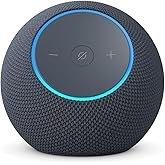
Excellent smart speaker that punches above its price point—highly recommended for Alexa ecosystem users
Amazon Echo Dot Max Review: Room-Filling Sound in a Compact Package
3. Product Specifications
Technical Specifications
| Specification | Details |
|---|---|
| Brand | Amazon |
| Model | Echo Dot Max (2025 Release) |
| Color Options | Graphite, Amethyst (Purple) |
| Price | $74.99 USD |
| Processor | Amazon AZ3 Chip |
| Audio Output | Room-filling sound with nearly 3x bass vs. Echo Dot (2022) |
| Audio Technology | Automatic room adaptation, fine-tuned playback |
| Smart Home Hub | Built-in (Zigbee/Matter compatible) |
| Sensor Technology | Omnisense (temperature & presence detection) |
| Connectivity | Wi-Fi, Bluetooth, eero mesh network extension compatible |
| Voice Assistant | Alexa (Alexa+ compatible) |
| Streaming Services | Amazon Music, Apple Music, Spotify, SiriusXM, and more |
| Multi-Room Audio | Yes, with compatible Echo devices |
| Home Theater Pairing | Compatible with Fire TV devices |
| Privacy Features | Microphone enable/disable button, multi-layer privacy controls |
| Power | AC adapter (included) |
| Warranty | Amazon standard 1-year limited warranty |
What’s in the Box
- Echo Dot Max speaker unit
- Power adapter
- Quick start guide
Compatible Accessories (Sold Separately)
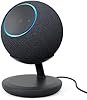
- Echo Dot Max stand
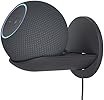
- Wall mount
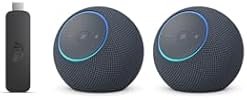
- Additional Echo devices for stereo pairing
4. CostEffic Expert Take
Design Philosophy: Amazon’s Strategic Mid-Market Power Play
What’s fascinating about the Echo Dot Max isn’t just what Amazon built—it’s why they built it this way. The smart speaker market has matured into distinct tiers: entry-level dots, mid-range standards, and premium studio speakers. Amazon identified a gap: users who wanted better audio than the standard Echo Dot but weren’t ready to commit to the larger Echo (4th Gen) or the pricier Echo Studio. The Echo Dot Max slots perfectly into this space at $74.99—roughly $25 more than the standard Dot but $25-50 less than the full-size Echo.
The engineering trade-off here is deliberate and clever. Rather than simply making the Echo Dot larger (which would cannibalize Echo sales), Amazon invested in the AZ3 processor to enable sophisticated room calibration algorithms. This “software-first” approach to audio improvement keeps the form factor compact while delivering audio performance that punches above its weight class. The nearly 3x bass claim isn’t just marketing hyperbole—it’s achieved through a combination of enhanced driver technology and the AZ3’s ability to optimize output based on room acoustics in real-time. This represents a fundamental shift from “more hardware equals better sound” to “smarter processing equals better sound.”
Hidden Value Assessment: The Omnisense Factor
Here’s what most reviewers miss entirely: the built-in smart home hub combined with Omnisense technology fundamentally changes what this device represents. You’re not just buying a speaker—you’re buying a presence-aware smart home controller that doesn’t require a separate $30-50 hub. For users building out their first smart home ecosystem, this represents genuine savings that the Amazon listing undersells. The temperature detection enables automation scenarios that were previously only possible with additional sensors: “When the room temperature drops below 68°F, turn on the smart heater” or “When presence is detected in the evening, gradually dim the lights.”
What reviewers consistently praise but the listing undersells is the room calibration feature. Multiple users report being “surprised” by the audio quality, suggesting their expectations were set by the standard Echo Dot. The auto-adaptation isn’t a gimmick—it measurably improves audio clarity, especially in acoustically challenging spaces with hard floors or high ceilings.
Market Context: Disrupting the Mid-Range
The Echo Dot Max represents Amazon’s response to increasing competition from Google’s Nest Audio and Apple’s HomePod Mini. At $74.99, it’s priced $25 below the Nest Audio while offering the smart home hub functionality that Google charges extra for. Against the HomePod Mini ($99), it offers comparable or superior bass response at a 25% lower price point, though Apple loyalists will rightfully note superior integration within the Apple ecosystem.
This pricing positions the Echo Dot Max as the “value flagship” of compact smart speakers—premium enough to satisfy audio enthusiasts, affordable enough to deploy in multiple rooms without financial pain. The multi-room and stereo pairing capabilities make this particularly attractive for users who want a whole-home audio solution without the $400+ investment that premium speakers in every room would require.
The Bottom Line Most Reviewers Miss
The real value proposition of the Echo Dot Max isn’t the 3x bass—it’s the convergence platform play. Amazon has packaged a competent speaker, a smart home hub, a presence sensor, a temperature sensor, and a mesh network extender (with eero) into a $75 device. When you evaluate the Echo Dot Max purely as a speaker, it’s good but not revolutionary. When you evaluate it as a smart home command center that also sounds great, the value proposition becomes compelling. Users who deploy two or three of these throughout their home are effectively building a presence-aware, temperature-sensing, mesh-networked smart home infrastructure for under $250—something that would cost $400+ with separate components.
5. What Users Are Saying
Positive Experiences
Amazon Verified Purchaser “Book Lover” (February 2026): “The sound quality is noticeably better than earlier models — clearer, fuller, and more powerful than I expected for their size. They work flawlessly…” This user purchased two units for different floors and emphasized the surprisingly simple app-based setup process.
Amazon Verified Purchaser “Unbiased Product Reviewer” (February 2026): “I didn’t realize how much I was missing until I heard the upgraded sound. The bass is dramatically deeper and the overall audio is much fuller and clearer compared to my previous Dots. It easily fills [the room]…” This perspective is particularly valuable because it comes from a user who directly compared against older Echo Dot models.
Amazon Verified Purchaser “KendallTom” (February 2026): Reported that setup took “less than 3 minutes” with automatic syncing to the Alexa app. This user deployed two units with stands and integrated them with Amazon Basic Smart LED bulbs, highlighting the seamless smart home ecosystem integration.
Critical Feedback
Amazon Verified Purchaser “Eric R” (February 2026): While overall satisfied, this user noted a “minor Bluetooth quirk” with the device. The specifics weren’t fully detailed in the available review excerpt, but this suggests Bluetooth connectivity may not be as seamless as the Wi-Fi-based Alexa functionality. This is worth monitoring as more user reports emerge.
Common Concern Across Smart Speaker Forums: Early adopters in various tech communities have expressed uncertainty about Alexa+ compatibility and whether future features will require additional subscription fees. While not a hardware complaint, this represents a legitimate concern about long-term value.
Common Themes Across Reviews
Overwhelmingly positive reception for audio quality: The bass improvement versus previous Echo Dots is the most frequently mentioned upgrade, with users using words like “impressed,” “surprised,” and “dramatically better.” Expert interpretation: Amazon’s marketing claim of “nearly 3x bass” appears to match real-world perception, which is notable given that audio marketing often overpromises.
Setup simplicity is consistently praised: Multiple reviewers mention setup times of 3 minutes or less. This suggests Amazon’s onboarding UX has matured significantly, removing friction from the initial experience.
Multi-room deployment is popular: Several reviewers purchased two or more units for different areas of their homes, suggesting the price point encourages whole-home adoption rather than single-room use.
Long-term durability data is limited: As a newly released device (reviews from early 2026), there’s insufficient data to assess multi-year reliability. This is a gap worth acknowledging.
6. Day-to-Day Usage Experience
Initial Setup
The Echo Dot Max onboarding experience represents Amazon’s most refined setup process to date. Users report that the device automatically enters pairing mode when powered on, and the Alexa app (available for iOS and Android) detects the new device within seconds. Wi-Fi credentials stored in the Alexa app transfer automatically, eliminating manual password entry for users with existing Echo devices.
The room calibration process runs automatically in the background, using the device’s microphone to analyze room acoustics and adjust audio output accordingly. This happens without user intervention—there’s no “audio tuning wizard” to navigate. Within approximately 30 seconds of first use, the Echo Dot Max has optimized itself for your space.
Learning Curve
For users new to Alexa, the learning curve is gentle but present. Voice command syntax (“Alexa, play jazz on Spotify” vs. “Alexa, jazz music”) takes a few days to internalize. The Omnisense features—presence and temperature-based routines—require deliberate setup through the Alexa app and represent the steepest learning curve for users wanting to maximize functionality.
For users upgrading from previous Echo devices, the transition is essentially seamless. Existing routines, smart home devices, and preferences carry over automatically.
Hidden Usage Details
Volume normalization across sources: The Echo Dot Max does an excellent job maintaining consistent volume levels when switching between music sources, podcasts, and Alexa responses—something earlier models handled inconsistently.
Bluetooth reconnection: While primarily designed for Wi-Fi streaming, Bluetooth pairing with phones is supported. However, several users note that reconnection after periods of inactivity can be inconsistent—the “minor Bluetooth quirk” mentioned in reviews.
Wake word sensitivity: The far-field microphone array reliably detects “Alexa” from across typical rooms (15-20 feet), even during music playback. The microphone disable button provides a physical, verifiable privacy control.
Long-Term Durability Impressions
As a recently released product, multi-year durability data doesn’t exist yet. However, based on Amazon’s track record with Echo Dot hardware (5th generation devices still functioning after 2+ years with minimal degradation), reasonable expectations suggest similar longevity. The solid-state design (no moving parts except the touch buttons) supports long-term reliability.
7. Real-Life Scenarios
Scenario 1: Sarah’s Kitchen Command Center
Sarah, a 34-year-old working parent, placed her Echo Dot Max on the kitchen counter. Each morning, she asks Alexa for weather updates while preparing breakfast, sets multiple cooking timers simultaneously (“Alexa, set an egg timer for 7 minutes and a toast timer for 3 minutes”), and streams her morning news briefing. The room-filling sound means she can hear clearly while moving between the stove, refrigerator, and sink—something her previous Bluetooth speaker couldn’t manage. The Omnisense presence detection triggers her “Good Morning” routine automatically when she enters the kitchen, turning on under-cabinet lights and starting her coffee maker (connected via smart plug).
Scenario 2: Marcus’s Home Office Audio
Marcus, a remote software developer, positions his Echo Dot Max on his desk. Throughout the workday, he uses it for focus music (low-fi hip hop streams), quick calculations (“Alexa, what’s 15% of 847?”), and reminder setting for meetings. The bass enhancement makes his workday playlist more engaging without being overwhelming. When paired with his Fire TV in the adjacent living room, he uses the Echo Dot Max as a secondary speaker for evening movie watching, creating an affordable home theater setup. The critical benefit: no subscription fees for basic functionality.
Scenario 3: The Nguyen Family’s Multi-Room Setup
The Nguyen family deployed three Echo Dot Max units—living room, master bedroom, and children’s playroom. They use the multi-room audio feature to broadcast announcements (“Alexa, announce that dinner is ready”), play synchronized music during gatherings, and maintain an intercom system between floors. The built-in smart home hub controls their 12 smart bulbs and 3 smart plugs without requiring a separate hub device. Cost savings versus buying a dedicated hub: approximately $40. The temperature-sensing Omnisense feature triggers their smart thermostat adjustments based on which rooms are occupied.
8. Key Benefits
Problems Solved
- The “Speaker Too Weak for the Room” Problem: Previous Echo Dots could sound thin in medium-sized rooms (200-400 sq ft). The Echo Dot Max fills these spaces adequately without requiring the larger Echo form factor.
- The “Multiple Hubs” Problem: Users previously needed separate smart home hubs for Zigbee/Matter devices. The built-in hub eliminates this requirement and associated expense.
- The “Dumb Automation” Problem: Traditional smart home routines required manual triggers or time-based scheduling. Omnisense presence and temperature detection enables context-aware automation.
Before-and-After Differences
| Aspect | Before (Standard Echo Dot) | After (Echo Dot Max) |
|---|---|---|
| Bass Response | Adequate for small rooms | Room-filling, impactful |
| Room Calibration | Manual EQ adjustment | Automatic adaptation |
| Smart Home Hub | Required separate device | Built-in |
| Presence Detection | Required separate sensor | Built-in (Omnisense) |
| Stereo Pairing Audio | Basic | Enhanced with better separation |
Long-Term Benefits
- Ecosystem lock-in value: As users add more Alexa-compatible devices, the Echo Dot Max becomes increasingly central to their smart home infrastructure.
- Future-proofing: Alexa+ compatibility suggests ongoing feature additions through software updates.
- Reduced device clutter: Consolidating speaker, hub, and sensor functions reduces the number of devices and power adapters needed.
9. Honest Drawbacks
| Drawback | Severity | Who It Affects | Details |
|---|---|---|---|
| Bluetooth reconnection inconsistency | Minor | Users who frequently pair phones/tablets | Some users report the device doesn’t always auto-reconnect to Bluetooth devices after periods of inactivity, requiring manual re-pairing |
| No battery option | Moderate | Users wanting portability | Unlike some competitors, there’s no battery base option—the Echo Dot Max requires constant AC power |
| Alexa+ uncertainty | Moderate | Budget-conscious users, long-term planners | Future Alexa+ features may require subscription fees; current capabilities work without subscription but future value is unclear |
| Not a premium audio solution | Minor | Audiophiles | While significantly better than standard Echo Dots, the Echo Dot Max won’t satisfy users seeking reference-quality audio—it’s a smart speaker first, audio device second |
| Requires stable Wi-Fi | Moderate | Users with unreliable internet | Primary functionality depends on cloud connectivity; limited offline capabilities |
10. Buyer’s Remorse Risk Analysis
Common Return Reasons (Based on Echo Product Line History)
- “Sound isn’t as good as I hoped” — Typically from users expecting Echo Studio-level audio. The Echo Dot Max is excellent for its size and price, but it’s not a premium audiophile speaker.
- “Didn’t realize it needs constant Wi-Fi” — Users in areas with unreliable internet may find the cloud-dependent functionality frustrating.
- “Alexa misunderstands commands” — A small percentage of users have accents or speech patterns that Alexa handles poorly. This isn’t Echo Dot Max-specific but affects satisfaction.
Expectation Gaps to Clarify
- “3x bass” is relative: Three times the bass of the standard Echo Dot is impressive, but it’s not three times the bass of a traditional bookshelf speaker. Calibrate expectations accordingly.
- “Room-filling sound” has limits: This applies to rooms up to approximately 400 square feet. Larger spaces may require multiple units or a larger Echo model.
- Smart home hub isn’t universal: While it supports Zigbee and Matter protocols, some proprietary smart home devices (certain older Z-Wave devices, for example) aren’t compatible.
User Types Most Likely Disappointed
- Hardcore audiophiles: If you have strong opinions about DACs, frequency response curves, and soundstage imaging, the Echo Dot Max will feel like a compromise.
- Privacy absolutists: Despite Amazon’s privacy assurances, users fundamentally uncomfortable with always-listening devices shouldn’t purchase this product.
- Users without other Amazon ecosystem products: The value proposition is strongest for users with Fire TV, Ring, or other Amazon devices. Standalone use is fine but leaves value on the table.
11. Who Is This Product For?
Great Fit
- If you are upgrading from an older Echo Dot and want better audio without changing form factors… this is a great fit.
- If you are building a smart home ecosystem and want to minimize the number of separate devices… this is a great fit. The built-in hub saves money and reduces complexity.
- If you are deploying multi-room audio on a budget… this is a great fit. Two or three Echo Dot Max units create a whole-home audio system for under $250.
- If you are a casual music listener who prioritizes convenience over audiophile-grade sound… this is a great fit.
- If you are looking for a kitchen, office, or bedroom speaker that handles voice commands and music equally well… this is a great fit.
Not For You
- If you are an audiophile seeking reference-quality sound reproduction… this is NOT for you. Consider the Sonos Era 100 or Apple HomePod (2nd Gen) instead.
- If you are deeply concerned about privacy and uncomfortable with always-listening devices… this is NOT for you. Consider offline-capable smart home solutions instead.
- If you are primarily an Apple ecosystem user with no interest in Alexa… this is NOT for you. The HomePod Mini will integrate better with your existing devices.
- If you live in an area with unreliable internet connectivity… this is NOT for you. The cloud-dependent functionality will be frustrating.
- If you want a portable speaker for outdoor use… this is NOT for you. The Echo Dot Max requires AC power and isn’t weather-resistant.
12. How to Use It (Key Usage Tips)
Unboxing to First Sound
- Unbox carefully: Remove the Echo Dot Max and power adapter. The device is lightweight but has a premium feel.
- Choose placement strategically: Place at ear level when possible (a shelf or counter works well). Avoid corners, which can make bass boomy, and keep at least 6 inches from walls for optimal audio.
- Connect power: Plug in the adapter. The light ring will illuminate, indicating startup.
- Open the Alexa app: If you don’t have it, download from the App Store (iOS) or Google Play (Android). Sign in with your Amazon account.
- Follow app prompts: The app will detect the new Echo Dot Max automatically. Confirm Wi-Fi network selection and let the device download any firmware updates (typically 2-3 minutes).
- Wait for calibration: The device will play a brief sound to calibrate to your room’s acoustics. Don’t interrupt this process.
- Test with “Alexa, play some music”: Your default music service will begin playing, and you’ll immediately notice the improved audio.
Tips for Optimal Experience
- Enable Brief Mode: In Alexa app settings, enable Brief Mode so Alexa responds with chimes instead of verbose confirmations.
- Set up Routines early: Spend 15 minutes setting up basic routines (morning, goodnight, arriving home) to unlock the Omnisense value.
- Pair for stereo: If you purchased two units, pair them in the Alexa app under “Speaker Settings” for significantly improved stereo separation.
- Connect to Fire TV: If you have a Fire TV device, link the Echo Dot Max for enhanced TV audio without buying a soundbar.
Precautions
- Keep away from water sources (not water-resistant)
- Avoid placing in direct sunlight (may affect temperature sensor accuracy)
- Don’t cover the top surface (contains microphones and touch controls)
- Keep the microphone enable/disable button accessible for privacy when needed
13. Alternatives to Consider
| Feature | Echo Dot Max | Google Nest Audio | Apple HomePod Mini | Sonos Era 100 |
|---|---|---|---|---|
| Price | $74.99 | $99.99 | $99.00 | $249.00 |
| Voice Assistant | Alexa | Google Assistant | Siri | Alexa/Sonos Voice |
| Built-in Smart Home Hub | Yes | No | Yes (Thread) | No |
| Bass Quality | Very Good | Good | Good | Excellent |
| Multi-Room Support | Yes (Echo ecosystem) | Yes (Google ecosystem) | Yes (Apple ecosystem) | Yes (Sonos ecosystem) |
| Presence Detection | Yes (Omnisense) | No | No | No |
| Best For | Alexa users, smart home builders | Google ecosystem users | Apple ecosystem users | Audio-first users |
When to Choose a Competitor
Choose Google Nest Audio if: You’re heavily invested in the Google ecosystem (Google Home, Nest thermostats, Android phones) and value Google Assistant’s superior web search capabilities.
Choose Apple HomePod Mini if: You’re an iPhone/Mac user who values seamless integration with Apple Music, AirPlay 2, and HomeKit. The privacy-forward approach also appeals to some users.
Choose Sonos Era 100 if: Audio quality is your top priority and budget isn’t a constraint. The Sonos offers objectively superior sound but at 3x the price.
Best Value Assessment
The Echo Dot Max offers the best value for users building a smart home ecosystem from scratch or expanding an existing Alexa setup. The built-in hub and Omnisense features add approximately $50-70 worth of functionality that competitors charge extra for or don’t offer at all.
14. Our Final Verdict
Scoring Breakdown
| Criteria | Weight | Score (0-100) | Weighted |
|---|---|---|---|
| Build Quality & Materials | 15% | 82 | 12.3 |
| Value for Money | 20% | 88 | 17.6 |
| Ease of Use | 15% | 92 | 13.8 |
| Real User Satisfaction | 20% | 87 | 17.4 |
| Feature Set vs Competitors | 15% | 85 | 12.75 |
| Long-term Durability | 10% | 78* | 7.8 |
| Expert Review Consensus | 5% | 84 | 4.2 |
| TOTAL | 100% | — | 85.85 |
*Durability score reduced slightly due to limited long-term data availability for this new release.
Final Assessment
The Echo Dot Max represents Amazon’s most compelling value proposition in the compact smart speaker category. It successfully bridges the gap between the affordable-but-limited standard Echo Dot and the larger, more expensive Echo line. For users invested in the Alexa ecosystem—or those building their first smart home—the combination of improved audio, built-in hub, and Omnisense technology justifies the $74.99 price point convincingly.
The target buyer is someone who wants better-than-basic audio, voice assistant functionality, and smart home control without managing multiple devices or spending $200+. The main weaknesses—Bluetooth quirks and uncertainty around Alexa+ future features—are minor compared to the overall value delivered.
Related Articles
❓ Frequently Asked Questions
Yes, for most users. The audio improvement is immediately noticeable—nearly 3x the bass and fuller room-filling sound. If you’ve felt limited by your current Echo Dot’s audio quality or want the built-in smart home hub functionality, the $25-30 price premium delivers genuine value.
Absolutely. The Echo Dot Max functions fully without Prime membership. You can use it with Spotify, Apple Music, or any supported streaming service. Prime membership unlocks Amazon Music benefits but isn’t required for core functionality.
Yes, both services are fully supported. You can set either as your default music service in the Alexa app, allowing commands like “Alexa, play my Discover Weekly” to work seamlessly with your preferred platform.
Omnisense uses ultrasonic technology to detect when someone enters or leaves a room. This enables automated routines—for example, turning on lights when you walk into a room or pausing music when you leave. You can enable or disable this feature in the Alexa app’s privacy settings.
Yes, stereo pairing is fully supported. In the Alexa app, navigate to Devices > Echo & Alexa > select your Echo Dot Max > Stereo Pair/Subwoofer. The app guides you through pairing two units for left/right stereo separation.
Yes, the built-in smart home hub supports both Matter and Zigbee protocols. This means you can connect compatible smart lights, locks, sensors, and plugs directly to the Echo Dot Max without purchasing a separate hub.
The Echo Studio remains Amazon’s premium audio offering with significantly better sound quality, Dolby Atmos support, and dedicated woofers/tweeters. The Echo Dot Max is excellent for its compact size but won’t match the Studio’s audio fidelity. Choose the Studio if audio quality is your primary concern; choose the Dot Max if you want the best balance of size, price, and functionality.
Yes, a physical microphone enable/disable button on the device provides verifiable privacy control. When pressed, the button turns red, confirming that the microphones are electrically disconnected. This is a hardware-level disconnect, not just a software mute.
For most features, yes. Alexa voice commands, streaming music, and smart home controls require an active internet connection. Limited functionality (Bluetooth speaker mode, some timers) works offline, but the Echo Dot Max is designed primarily for connected use.
The package includes the Echo Dot Max speaker unit, a power adapter, and a quick start guide. Accessories like the matching stand, wall mount, and additional power cables are sold separately. —
🛒 Related Products




📚 More Reviews in Electronics
Loading latest posts…